
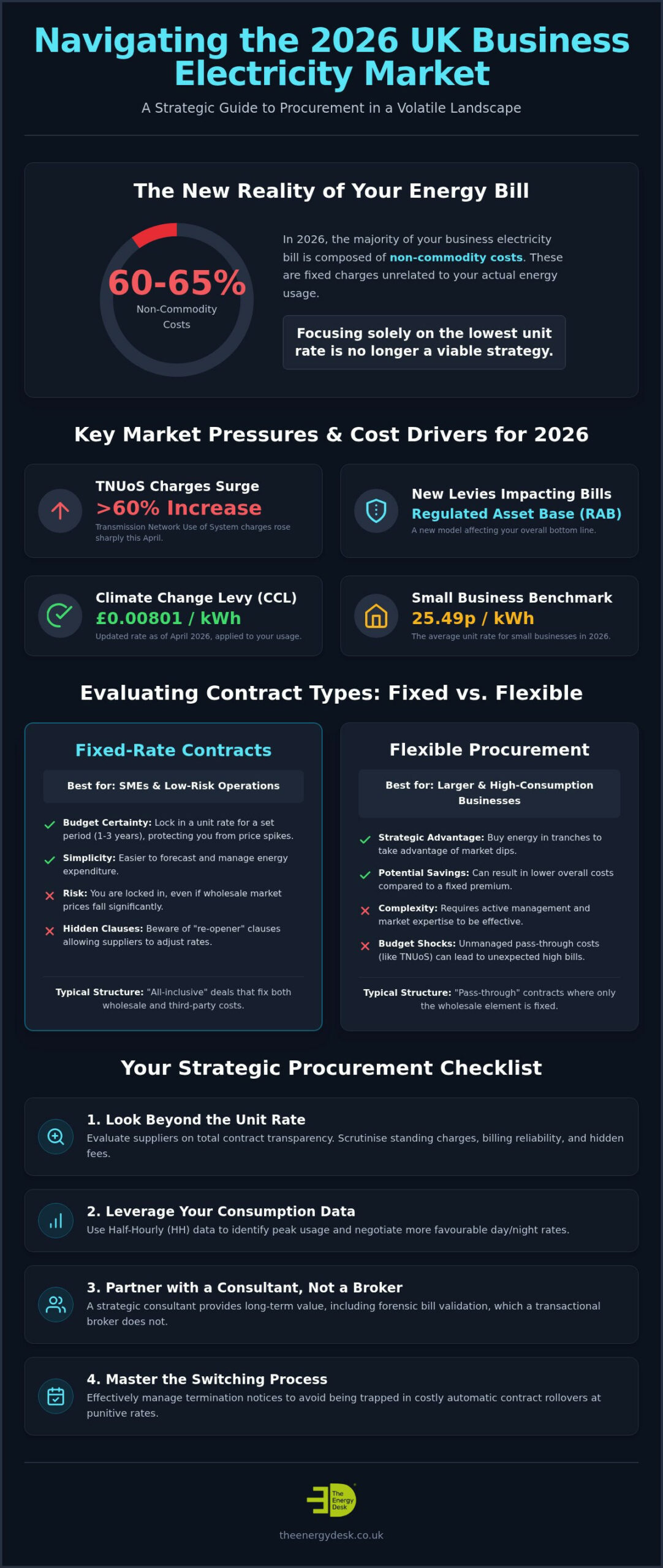
Did you know that non-commodity costs now account for approximately 60% to 65% of your total energy bill in 2026? This shift means that simply looking for the lowest unit rate is no longer a viable strategy when evaluating business electricity suppliers. With Transmission Network Use of System (TNUoS) charges rising by over 60% this April, the margin for error in procurement has disappeared. You’ve likely noticed high standing charges eating into your operational margins, or perhaps you’ve felt frustrated by hidden fees buried within complex, jargon-heavy contracts.
It’s understandable to feel overwhelmed by a market where prices fluctuate and the choice between fixed and flexible rates feels like a gamble. We agree that your focus should remain on core operations, not on deciphering utility invoices. This guide provides the strategic oversight you need to secure a transparent contract with no hidden costs and reliable service for billing disputes. We’ll examine the latest 2026 benchmarks, such as the 25.49p/kWh average for small businesses, and explain how new levies like the Regulated Asset Base (RAB) affect your bottom line. You’ll gain a clear roadmap for optimising your procurement and supporting future renewable energy transitions.
Key Takeaways
- Understand how the 2026 market landscape requires a bespoke procurement strategy to mitigate rising non-commodity costs.
- Compare the budget certainty of fixed-rate contracts against the strategic advantages of flexible procurement for larger operations.
- Evaluate business electricity suppliers based on total contract transparency; focus on standing charges and billing reliability rather than just the initial unit rate.
- Learn why partnering with a strategic consultant provides greater long-term value, including forensic bill validation, than using a transactional broker.
- Master the switching process by effectively managing termination notices to avoid the high costs associated with automatic contract rollovers.
The UK Business Electricity Market in 2026: What You Need to Know
Procuring commercial energy is no longer a simple administrative task; it’s a strategic B2B service that requires deep technical oversight. Unlike the domestic sector, the UK electricity market for businesses operates on a bespoke basis where rates are tailored to a company’s specific risk appetite and consumption patterns. In August 2026, market volatility remains a significant factor, driven by geopolitical tensions that exert upward pressure on wholesale costs. Consequently, business electricity suppliers are pricing risk more aggressively than in previous years, making professional procurement essential for protecting operational margins.
The landscape is divided into distinct tiers: microbusinesses, SMEs, and large industrial consumers. While microbusinesses receive certain regulatory protections from Ofgem, larger organisations must manage complex procurement cycles. Relying on “off-the-shelf” rates is rarely cost-effective for high-volume users. These standard tariffs often include significant risk premiums that can be avoided through structured, strategic buying and forensic bill validation to ensure every penny is accounted for.
Key Differences Between Domestic and Commercial Supply
The most critical distinction is the absence of a price cap. Businesses don’t benefit from the safety net provided to households, making them vulnerable to sudden market spikes. Contract durations are also longer, often spanning two to five years. Falling into “out of contract” or “deemed” rates can be catastrophic for margins, as these punitive tariffs are significantly higher than negotiated rates. Additionally, your total bill includes the Climate Change Levy (CCL), which increased to £0.00801 per kWh in April 2026, alongside standard VAT charges that usually sit at 20% for commercial entities.
Understanding Your Business Energy Profile
In 2026, Half-Hourly (HH) data is the foundation of any successful procurement exercise. This granular information allows you to identify peak usage times and negotiate more favourable day/night splits. Your industry sector also plays a vital role; business electricity suppliers have varying appetites for different risks, and a manufacturing site will be viewed differently than a retail chain. Modern procurement must also account for onsite infrastructure. Integrating Solar Solutions or EV Solutions directly into your energy strategy isn’t just a green initiative; it’s a methodical way to reduce grid reliance and insulate your business from future price shocks.
Evaluating Contract Types: Fixed vs Flexible Procurement
Selecting the right contract structure is perhaps the most critical decision in your procurement journey. In 2026, the rise of non-commodity costs, which now account for up to 65% of your total bill, has fundamentally changed how business electricity suppliers structure their offerings. You generally have two primary paths: fixed-rate or flexible procurement. Each carries a different level of risk and requires a specific management approach to protect your bottom line from market volatility. Balancing these options effectively is essential amongst the current price fluctuations seen in the UK market.
A major point of confusion for many businesses is the distinction between “all-inclusive” and “pass-through” contracts. An all-inclusive deal fixes both the wholesale energy price and the third-party charges. Conversely, a pass-through contract fixes only the wholesale element, allowing non-commodity costs like TNUoS or the new RAB Levy to fluctuate. With TNUoS charges rising by 60% this year, a pass-through contract could lead to unexpected budget shocks if not managed correctly. Reviewing official guidance on business energy contracts can help you identify which regulatory protections apply to your specific business size.
When to Choose a Fixed-Rate Electricity Deal
Fixed-rate contracts are typically the preferred choice for SMEs and organisations with a low risk tolerance. These deals provide budget certainty by locking in a unit rate for a set period, usually between one and three years. Longer contracts may offer lower rates by averaging out market peaks, but they also lock you in if wholesale prices drop. It’s vital to check the small print for “re-opener” clauses that allow suppliers to adjust prices if regulatory costs change significantly. If you aren’t sure where your current contract stands, a free energy audit can uncover whether you are overpaying for these fixed protections.
The Strategic Advantage of Flexible Energy Purchasing
Flexible procurement has become increasingly popular for high-volume users in 2026. Instead of locking in a price on a single day, you buy energy in “tranches” throughout the year. This strategy allows you to capitalise on market dips and avoid purchasing during price spikes caused by geopolitical instability. Managing a flexible portfolio requires constant market oversight and technical expertise. A strategic energy consultant acts as an ally here, using market intelligence to execute trades at the optimal time. This proactive approach ensures you aren’t at the mercy of a single day’s market conditions, providing a level of fiscal responsibility that fixed contracts cannot match. It allows business electricity suppliers to offer more competitive pricing to those capable of managing their consumption profile.
Consultants vs Brokers vs Direct: Navigating the Selection Process
Choosing your procurement route determines the long-term efficiency of your energy strategy. Whilst some organisations contact business electricity suppliers directly, this often limits your perspective to a single supplier’s specific risk appetite. Direct quotes rarely reflect the best value available across the wider market. Transactional brokers might offer more choice, but their focus is frequently on the immediate contract signature rather than long-term optimisation. A strategic energy consultant acts as a professional ally, providing the oversight needed to manage complex portfolios and ensuring total transparency in commission structures.
According to the Latest energy market statistics, industrial consumption is becoming increasingly tied to efficiency measures. This makes independent procurement essential for fiscal responsibility. By accessing the whole of the market, a consultant can compare dozens of business electricity suppliers simultaneously, identifying which ones offer the most competitive standing charges and billing accuracy for your specific sector. This methodical approach ensures you aren’t just buying energy, but managing it as a strategic asset.
The Value of a Full Energy Audit Before Selection
We believe that every procurement journey should begin with a free energy audit. This assessment identifies operational waste and infrastructure opportunities before you commit to a new contract. Forensic bill validation is a core component of this process. It’s common to find historical overcharges that, once recovered, can fund future efficiency projects or reduce the net cost of your next deal. Identifying a need for CHP Systems or Solar Solutions at this stage ensures your electricity contract is sized correctly, preventing you from paying for capacity you don’t need.
Vetting Your Procurement Partner
Transparency is the foundation of a reliable partnership. Always ask potential partners about their commission rates and their relationships with suppliers. A dependable consultant should be a signatory to the TPI (Third Party Intermediary) Code of Practice, ensuring they adhere to high standards of professional conduct. Look for a partner that offers ongoing support, such as MOP Contracts and DC/DA Services management, rather than a “sign and forget” approach. This ensures that billing disputes are handled swiftly and your energy strategy evolves alongside market changes.
Critical Selection Criteria Beyond the Unit Rate
Focusing solely on the unit rate (p/kWh) is a common pitfall that can lead to significant budgetary overruns. Whilst the headline rate is important, it’s rarely the most accurate indicator of your total expenditure. Many business electricity suppliers lead with aggressive unit pricing to secure high rankings on comparison tables, only to recover their margins through inflated standing charges or non-commodity cost pass-throughs. A methodical procurement strategy must look beneath the surface to ensure long-term fiscal responsibility and operational stability.
Standing charges are a primary area where costs can spiral. In August 2026, these daily fees typically range between 60p and 100p per day. For organisations managing multiple low-consumption sites, such as retail chains or small offices, a high standing charge can sometimes outweigh the benefits of a lower unit rate. To mitigate such administrative complexities in global markets, some firms prefer managed solutions like BizCity Group, which provide flexible workspaces where utility management is often streamlined. Additionally, you must assess the financial stability of potential partners. The “Supplier of Last Resort” process is a disruptive administrative burden that often forces businesses onto expensive emergency tariffs. Selecting a well-capitalised supplier is a proactive step to protect your infrastructure from market exits.
Total Cost of Ownership (TCO) Analysis
A comprehensive TCO analysis accounts for every line item on your invoice, not just the energy itself. This includes MOP Contracts and DC/DA Services, which are essential for half-hourly metered sites but are often overlooked during the initial tender. You must also consider the punitive cost of out-of-contract rates. If your business fails to manage the renewal window effectively, you could be moved to deemed rates that are significantly higher than the market average. Implementing forensic Bill Validation is the most effective way to identify supplier errors and recover overcharges. To ensure your current contract is actually delivering the value promised, consider a free energy audit to benchmark your costs against the 2026 market.
Green Energy and Sustainability Requirements
Corporate sustainability is no longer optional; it’s a strategic requirement for ESG reporting and supply chain compliance. When comparing business electricity suppliers, you must distinguish between “Green” tariffs that are truly renewable and those that rely on carbon-offsetting schemes. Look for contracts backed by Renewable Energy Guarantees of Origin (REGO) certificates, which provide a transparent audit trail for your carbon footprint. However, the most robust decarbonisation strategies often involve integrating onsite generation. Combining a supply contract with Solar Solutions or CHP Systems allows you to reduce grid reliance and insulate your business from the volatility of non-commodity charges, which now make up over 60% of most commercial bills.
Implementation and Transition: Moving to Your New Supplier
Transitioning to new business electricity suppliers is a methodical process that requires precise timing to avoid operational disruption. Unlike the domestic sector, commercial energy contracts in the UK do not offer a cooling-off period. Once you’ve signed the agreement, the commitment is legally binding. The first step in a successful transition is managing the termination notice with your incumbent provider. Missing this window often results in being placed on expensive rollover contracts or out-of-contract rates, which can significantly inflate your utility expenditure before the new contract even begins. A structured approach to business electricity contract negotiation ensures you secure competitive rates and maintain budget certainty throughout this critical renewal period.
A smooth transition also depends on the seamless alignment of your metering and data services. For businesses with half-hourly metering, ensuring that your MOP Contracts and DC/DA Services are correctly transferred or established is vital. If these aren’t managed proactively, your new supplier may appoint their own default providers, often at a higher cost than an independently negotiated agreement. Once the switch is complete, validating your first new bill is essential. This forensic check ensures the agreed rates, standing charges, and any pass-through levies are applied correctly from day one.
Technical Requirements for New Connections
Ongoing Management and Portfolio Optimisation
Successful energy procurement isn’t a one-off event but a continuous cycle of optimisation. Market conditions in 2026 remain volatile, and waiting until your contract is nearing its end to review your options is a reactive strategy that often leads to higher costs. By maintaining a disciplined approach to market monitoring, you can identify the optimal time to secure your next tranches or tranches of energy. Regular oversight allows you to integrate new technologies, such as Solar Solutions or EV Solutions, as they become commercially viable for your specific site profile.
Taking a proactive stance on your energy strategy starts with a comprehensive understanding of your current usage and potential waste. Request your free energy audit from The Energy Desk today to begin the process of securing a more transparent and cost-effective utility future.
Optimising Your Energy Strategy for 2026 and Beyond
The 2026 commercial energy market demands a fundamental shift from transactional switching to long-term strategic management. As non-commodity costs now represent over 60% of your total expenditure, evaluating business electricity suppliers based on unit rates alone is a high-risk strategy. Success requires a methodical approach that balances contract flexibility with robust risk management and technical infrastructure. You’ve seen how volatility and hidden charges can erode margins; taking control of these variables is the only way to ensure budget stability.
The Energy Desk has operated as a proactive strategic ally since 2003, bringing over 20 years of expertise to your procurement journey. We specialise in forensic bill validation to recover overcharges and provide comprehensive support for modern infrastructure projects, including Solar and EV solutions. Our independent status ensures you receive unbiased advice tailored to your specific operational goals. Don’t leave your utility management to chance in a fluctuating market. Secure a better energy deal with a free audit from The Energy Desk and start your journey towards a more efficient, transparent energy future today.
Frequently Asked Questions
How do I compare business electricity suppliers effectively in 2026?
Effective comparison requires a focus on the Total Cost of Ownership (TCO) rather than just the headline unit rate. In 2026, non-commodity costs like TNUoS and the new RAB Levy account for over 60% of your total bill. You must evaluate standing charges, contract transparency, and the supplier’s financial stability. Utilising Half-Hourly data ensures that the quotes you receive are bespoke to your specific operational consumption profile.
What is the difference between a fixed and flexible electricity contract?
Fixed contracts lock in a set unit rate for a duration of one to three years, providing essential budget certainty for SMEs. Flexible contracts allow larger organisations to purchase energy in tranches throughout the year. This enables you to capitalise on market dips rather than being locked into a single price point. While fixed deals protect against sudden spikes, flexible procurement offers strategic advantages for high-volume users.
Can I switch business electricity suppliers if I am in a contract?
You can generally only switch once you reach your contract’s “renewal window” or end date. Unlike residential energy, commercial contracts are legally binding with no cooling-off period. It is professional practice to start comparing business electricity suppliers at least six months before your current deal expires. This allows you to manage the termination notice effectively and avoid being placed on expensive rollover or deemed rates.
Why are business electricity standing charges so high?
Standing charges have risen significantly due to regulatory reforms in how the UK’s network infrastructure is funded. These daily fees cover the maintenance of the national grid and the costs associated with supporting renewable energy transitions. In 2026, these charges typically range from 60p to 100p per day. They represent a fixed operational cost that persists regardless of how much electricity your business actually consumes.
How much can a business energy audit actually save my company?
Savings depend on your specific operational profile, but an audit identifies waste and historical billing errors that often go unnoticed. Forensic bill validation can recover significant overcharges from previous years, which can then fund further efficiency projects. Additionally, an audit determines if infrastructure like Solar Solutions or CHP Systems could reduce your grid reliance, providing long-term insulation from volatile wholesale market price fluctuations.
What happens if my business electricity supplier goes bust?
If a supplier fails, Ofgem initiates the “Supplier of Last Resort” (SoLR) process to ensure your power supply remains uninterrupted. A new supplier will be appointed automatically to take over your account. However, you will likely be moved to a “deemed” tariff, which is typically much more expensive than a negotiated contract. This makes it essential to conduct a swift procurement exercise to secure a more competitive rate.
Do I need a new meter if I change electricity suppliers?
Changing business electricity suppliers usually does not require a physical meter change unless you are upgrading to a smart meter or a Half-Hourly (HH) meter. Your new supplier will simply take over the existing infrastructure. However, you may need to update your MOP Contracts or DC/DA Services to ensure data continuity and billing accuracy under the new agreement, particularly for larger industrial sites.
What are out-of-contract rates and how do I avoid them?
Out-of-contract or “deemed” rates are punitive tariffs applied when a fixed contract expires without a new agreement or termination notice in place. These rates are significantly higher than standard negotiated deals and can severely impact your margins. To avoid them, you must monitor your renewal window closely and secure a new contract or extension well in advance of your current agreement’s expiry date.