
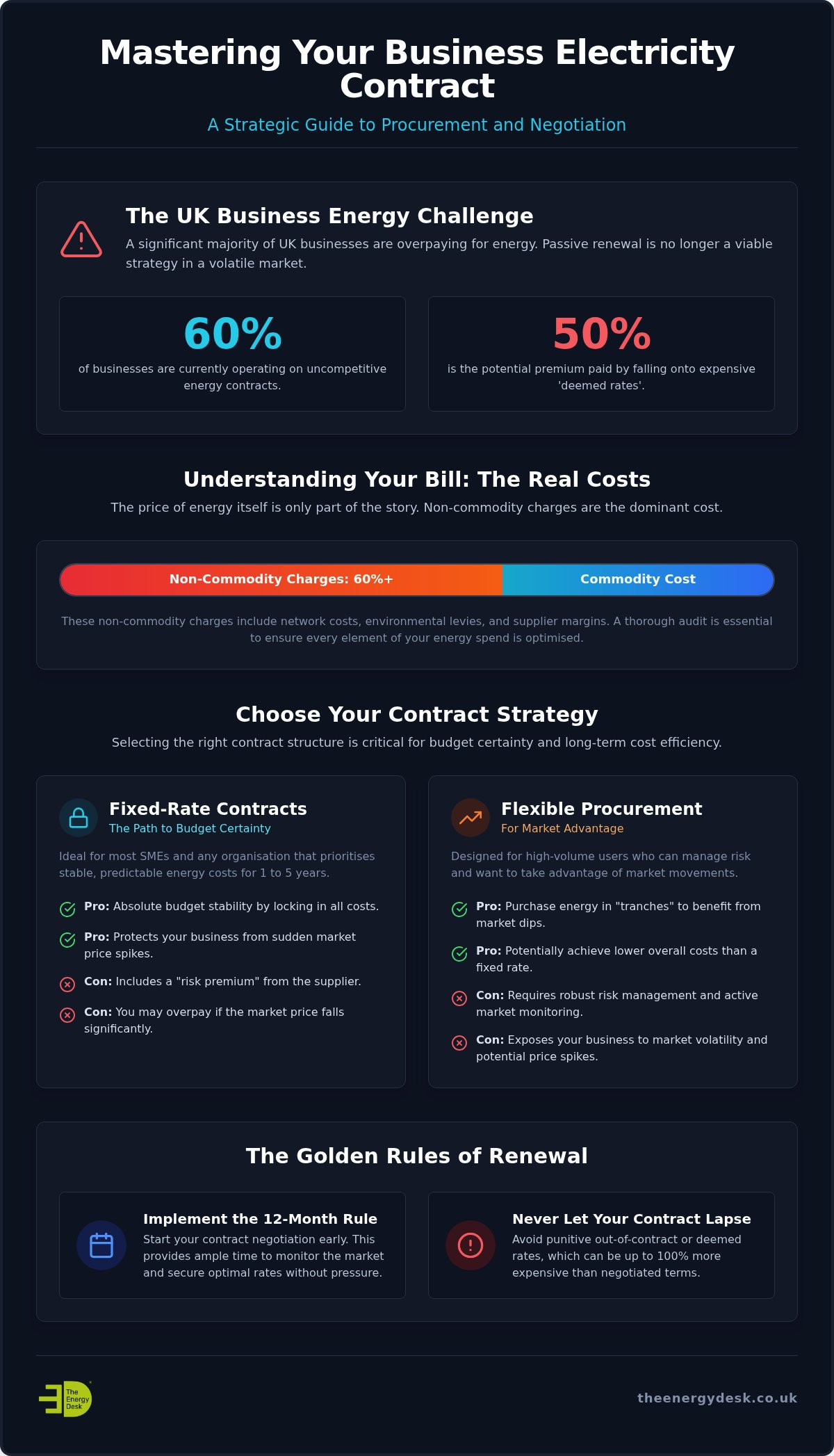
Approximately 60% of UK businesses are currently operating on uncompetitive energy contracts, with many paying a premium of up to 50% simply by falling onto expensive deemed rates. In a volatile market where non-commodity charges now account for over 60% of your total bill, passive renewal is no longer a viable strategy. It is understandable that the technical jargon surrounding commodity versus non-commodity costs feels designed to obscure the true price of your power.
This guide empowers you to master the complexities of commercial energy procurement and refine your approach to business electricity contract negotiation. By following our methodical framework, you will learn how to secure competitive rates and maintain budget certainty for the next 12 to 36 months. We will examine the critical timelines for renewal, the impact of rising standing charges from April 2026, and the precise steps required to ensure a seamless transition between suppliers whilst avoiding the pitfalls of expensive out of contract pricing. This professional oversight ensures your utility management remains a strategic asset rather than an uncontrolled overhead.
Key Takeaways
- Identify your specific renewal window to prevent being rolled onto expensive deemed rates that can cost up to 50% more than market averages.
- Evaluate the strategic benefits of fixed-rate contracts for long-term budget certainty versus flexible procurement for purchasing energy in market-aligned tranches.
- Implement the 12-month rule to start your business electricity contract negotiation early, allowing ample time to monitor wholesale market volatility and secure optimal unit prices.
- Uncover hidden non-commodity charges and rising standing charges within your bill to ensure every element of your energy spend is audited and optimised.
- Gain access to exclusive wholesale-only rates and reduce administrative burdens by leveraging professional procurement expertise and independent energy audits.
Navigating the Business Electricity Contract Renewal Window
A business electricity contract renewal represents the formal process of renegotiating terms and prices before your current agreement expires. It is not merely an administrative task; it’s a strategic opportunity to re-evaluate your consumption and secure market-aligned pricing. Identifying your renewal window is the first step. This is the specific timeframe where you can legally agree a new contract that will commence once your existing term ends. Engaging in business electricity contract negotiation well before your end date allows you to hedge against market volatility and avoid the pressure of last-minute decisions.
A significant risk for UK businesses is the automatic renewal clause found in many standard agreements. If you fail to provide notice or agree to a new deal, your supplier may legally roll your account onto a new fixed-term contract. These rollover rates are rarely competitive and can lock your organisation into expensive pricing for an additional 12 months. Proactive oversight is essential to prevent this outcome and maintain control over your utility expenditure.
The Risks of Missing Your Renewal Date
Allowing a contract to lapse without a replacement agreement results in immediate financial penalties. Suppliers will typically move your account onto out-of-contract rates. These are standard variable tariffs that are significantly higher than fixed-term prices. If you move into a new premises without a pre-arranged agreement, you’ll be placed on deemed rates. In the current UK market, these emergency tariffs can inflate your monthly energy overheads by up to 100%. This unnecessary drain on capital occurs whilst a business remains undecided, making it one of the most avoidable costs in commercial operations; similarly, ensuring your previous site is properly vacated with the help of Dynamic Pro Clean Ltd can prevent further avoidable expenses related to end-of-tenancy cleaning obligations.
Micro Business vs Large Corporate Renewals
The rules governing business electricity contract negotiation vary depending on the size of your organisation. Micro businesses benefit from specific Ofgem protections, such as the removal of the requirement to provide a formal termination notice for certain contract types. This offers greater flexibility when switching suppliers. Conversely, large corporate entities face more complex requirements. For these organisations, providing accurate Half-Hourly (HH) data is critical to obtaining precise renewal quotes. Suppliers use this granular consumption data to assess risk and price the contract accordingly. Before starting the tender process, ensure your Letter of Authority (LOA) status is current. This document permits your consultant to act on your behalf, ensuring a streamlined procurement process.
Understanding Fixed, Flexible, and Pass-through Renewal Options
Selecting the right contract structure is a pivotal phase of business electricity contract negotiation. Businesses typically choose between three primary frameworks: fixed, flexible, or pass-through agreements. Each model carries distinct implications for budget certainty and long-term cost efficiency. Your choice should align with your organisation’s risk appetite and cash flow requirements, as the difference between these structures can impact your total spend by thousands of pounds over a multi-year term.
The Pros and Cons of Fixed-Rate Certainty
Fixed-rate contracts remain the preferred choice for most small to medium-sized enterprises (SMEs) because they lock in both commodity and non-commodity costs for a term of one to five years. This provides absolute budget stability. However, it’s essential to understand the “risk premium” baked into these deals. Suppliers include this margin to safeguard themselves against market volatility. In 2026, locking into a long-term fix during a market peak could leave your business overpaying for years. It’s often beneficial to conduct a free energy audit to determine if current market conditions favour a fixed approach or if a shorter term is more strategic.
Flexible Procurement for High-Volume Users
Flexible procurement allows high-volume users to purchase energy in “tranches” rather than securing the entire requirement at a single point in time. This strategy enables you to buy “baseload” and “peak” requirements separately, taking advantage of market dips whilst avoiding temporary spikes. Success in flexible procurement requires a robust risk management plan and ongoing market monitoring. It isn’t a “set and forget” solution; it demands a proactive partner who can execute trades when the market is favourable.
For organisations that prioritise transparency, pass-through contracts offer an alternative to fixed non-commodity charges. In a standard fixed deal, third-party charges like DUoS (Distribution Use of System) and TNUoS (Transmission Network Use of System) are often marked up by the supplier to cover their own risk. Pass-through agreements charge you the actual cost of these levies as they occur. Whilst this removes hidden supplier margins, it requires your business to have the cash flow flexibility to handle seasonal fluctuations in network costs. Effective business electricity contract negotiation involves weighing these transparent savings against the need for monthly cost consistency.
Strategic Timing: When Should You Start Negotiating Your Next Contract?
Strategic timing is often the deciding factor in successful business electricity contract negotiation. Whilst many SMEs wait until their renewal letter arrives, the most efficient organisations begin the process at least 12 months in advance. This lead time allows you to monitor the wholesale market and identify favourable entry points rather than being forced to accept whatever rates are available in the final weeks of a contract. By the time your current agreement reaches its final quarter, your options for price protection have already narrowed significantly.
Suppliers price future contracts based on the “Forward Curve”, which is the projected cost of energy for 2027 and beyond. During 2026 negotiations, global geopolitical events and fluctuations in UK grid demand directly influence these projections. Starting early enables you to lock in a price when the forward curve dips, effectively insulating your budget from future spikes. It’s also vital to issue a formal termination notice to your current supplier early. Failing to do so can trigger evergreen rollovers, where you’re automatically moved to uncompetitive rates without the opportunity for further discussion.
The 12-Month Renewal Countdown
A structured timeline ensures no detail is overlooked. Between months 12 and 9, focus on data collection and forensic bill validation to establish an accurate consumption profile. From months 9 to 6, conduct a thorough market analysis to decide whether a fixed, flexible, or renewable-backed contract best serves your operational goals. Finally, between months 6 and 3, launch the formal tender process amongst multiple suppliers. This creates the competitive tension necessary to drive down supplier margins and secure the most advantageous terms available in the market.
Using Market Volatility to Your Advantage
Professional market-watch services provide a significant edge by alerting you when wholesale prices reach a specific target threshold. This proactive approach allows you to strike when the market is weak rather than when your contract is expiring. Timing your renewal to avoid the “Winter Premium” is another effective tactic, as renewing in the summer months often yields better results. Increased demand for heating and lighting during the colder months typically drives UK wholesale electricity prices higher due to tighter supply margins. By planning your business electricity contract negotiation around these seasonal cycles, you can capture lower rates that are unavailable during peak demand periods.
Identifying Hidden Costs: Non-Commodity Charges and Standing Charges
Non-commodity costs represent the most significant portion of a modern commercial energy bill. These charges include Distribution Use of System (DUoS) and Transmission Network Use of System (TNUoS) fees, alongside government levies such as the Green Gas Levy. Since the implementation of the Targeted Charging Review (TCR), the way businesses are billed for grid maintenance has shifted. This regulatory change moved many costs from the unit rate into fixed daily standing charges. Because these components now account for over 60% of your total spend, they must be a priority during business electricity contract negotiation. When evaluating business electricity suppliers in 2026, understanding how each provider structures and marks up these non-commodity charges is just as important as comparing unit rates.
Standing charges are rising significantly across the UK as network operators recoup the costs of infrastructure upgrades. Whilst these are often viewed as non-negotiable, different suppliers apply varying margins to these pass-through costs. A methodical review of your standing charges can reveal opportunities for substantial savings that a simple unit-price comparison would overlook.
Forensic Bill Validation During Renewal
The renewal window is the ideal time to perform a forensic audit of your historical billing. Many organisations discover they’ve been overcharged for years due to administrative errors or incorrect tariff applications. Identifying these discrepancies provides powerful leverage during business electricity contract negotiation. It’s also vital to check for “Estimated” readings. If your previous contract was based on estimates rather than actual data from a SMETS2 or traditional meter, your consumption profile will be skewed. This inaccuracy leads to suppliers over-pricing their risk. Our bill validation and forensic auditing services ensure your new agreement is founded on precise consumption data.
Optimising Your kVA and Reactive Power
Businesses frequently pay for “ghost capacity” they never actually require. Your Agreed Capacity (kVA) is the volume of electricity the local network reserves for your site. If your kVA is set higher than your peak demand, you’re paying a premium for unused grid space. Adjusting your kVA to reflect your actual requirements can lead to immediate, permanent reductions in your daily standing charges. Addressing “Reactive Power” penalties is also essential for operational efficiency. These charges occur when your on-site equipment operates inefficiently, drawing more current than necessary. Implementing Power Factor Correction can eliminate these penalties, ensuring your total utility spend is fully optimised before you sign a new agreement.
Professional Procurement: Why Partnering with an Energy Consultant
Direct suppliers and online comparison sites often present a limited view of the market, typically restricted to their own products or a small selection of partners. Partnering with an independent consultant provides access to “wholesale-only” rates that aren’t advertised to the general public or available through standard portals. This is a critical advantage during business electricity contract negotiation, as it allows for a broader comparison of terms across a wider panel of suppliers. A consultant acts as a strategic ally, ensuring that your procurement decisions are based on comprehensive market data rather than a supplier’s sales targets.
Beyond simple price discovery, a consultant manages the significant administrative burden associated with utility management. This includes overseeing the entire tender process, handling complex supplier queries, and ensuring that termination notices are served correctly within the required windows. By outsourcing these technical tasks, your internal finance and facilities teams can focus on core operations whilst having the confidence that your energy portfolio is being managed by seasoned experts. We act as the single point of contact, resolving disputes and validating that every term in your new agreement is honoured.
The Energy Desk Approach to Renewal
Our process begins with a free, comprehensive energy audit. This initial step is designed to identify immediate saving opportunities and historical inefficiencies within your current billing. We don’t just look at the unit price; we tailor contracts to support your wider sustainability goals. This may include integrating Solar PV or EV infrastructure solutions directly into your procurement strategy. To ensure a seamless transition, we provide a dedicated account manager who oversees the entire switch, proactively preventing the risk of your business being rolled onto expensive deemed rates. This personalised oversight ensures that your business is never left exposed to market volatility during the handover period.
Beyond the Contract: Long-term Energy Strategy
A robust energy strategy extends beyond the signing of a single contract. We help organisations reduce their reliance on the National Grid by exploring CHP (Combined Heat and Power) systems, which offer significant operational efficiencies for high-usage industrial and commercial sites. Accuracy in data collection is also paramount for future cost control. Our DC/DA services ensure your half-hourly data is collected and processed correctly, providing the forensic level of detail required for future business electricity contract negotiation. This long-term oversight ensures your utility costs remain optimised throughout the contract lifecycle, allowing for proactive adjustments as market conditions or your operational needs evolve.
Ready to secure your 2026 rates? Contact The Energy Desk for a free audit today.
Strategic Utility Management for 2026 and Beyond
Successful business electricity contract negotiation is built on proactive timing and a granular understanding of your consumption data. By identifying your renewal window early and auditing non-commodity charges, you protect your organisation from the volatility of deemed rates and rising standing charges. Transitioning from a passive renewal to a strategic procurement model ensures your energy costs remain a managed variable rather than an uncontrolled risk.
The Energy Desk has operated as a leading independent consultancy since 2003, specialising in complex half-hourly and industrial procurement across the UK. Our methodology includes forensic bill validation to recover historical overcharges and identify “ghost capacity” that unnecessarily inflates your monthly overheads. We provide the technical oversight required to simplify a complex market, ensuring every contract term aligns with your operational goals and budget requirements.
Request your free business energy audit and renewal quote to secure your 2026 rates with confidence. Taking control of your energy portfolio today ensures long-term fiscal stability and efficiency for your business.
Frequently Asked Questions
When is the best time to renew my business electricity contract?
The optimal time to begin the renewal process is 12 months before your current agreement expires. This extended lead time allows you to monitor wholesale market volatility and secure a contract when the forward curve dips. By starting early, you avoid being forced into a high-rate agreement during a period of peak market demand or seasonal price spikes.
What happens if I miss my renewal date and go out of contract?
If you miss your renewal date, your supplier will move your account onto out-of-contract or deemed rates. These tariffs are significantly more expensive than fixed-term deals, often increasing your monthly costs by up to 100%. Additionally, you may be rolled onto a new 12-month contract with uncompetitive terms if your original agreement included an automatic renewal clause.
Can I switch suppliers if I have an outstanding debt on my account?
Suppliers will typically block any attempt to switch if there is an outstanding balance on your account. You must clear all overdue invoices or resolve any ongoing billing disputes before a new supplier can take over the lead. Once the debt is settled, the current supplier will remove their objection, allowing the transfer process to proceed as planned.
How long does the business electricity switching process take?
The administrative transfer of a supply usually takes between 15 and 30 days once the new agreement is signed. However, the complete business electricity contract negotiation and tender phase should be initiated months in advance. This ensures that termination notices are served correctly and credit checks are passed well before your existing fixed term reaches its conclusion.
What information do I need to provide for an electricity renewal quote?
You need to provide a recent copy of your energy bill, which contains your MPAN (Meter Point Administration Number) and current contract end date. Accurate annual consumption data is also required to ensure the quotes reflect your actual usage. For larger organisations, providing half-hourly data is essential for suppliers to price the specific risk profile of your site accurately.
Is it better to choose a fixed or flexible electricity contract in 2026?
Fixed-rate contracts are generally better for SMEs seeking budget stability and protection against market spikes for up to five years. Flexible contracts are more suitable for high-volume users who can purchase energy in tranches to take advantage of market dips. The right choice depends on your cash flow requirements and your ability to manage ongoing market exposure throughout the contract term.
What are non-commodity charges and can they be negotiated?
Non-commodity charges cover grid maintenance and government levies, such as DUoS and TNUoS. Whilst the base rates for these levies are set by regulators, the margins suppliers apply to them can vary between quotes. A detailed business electricity contract negotiation involves auditing these pass-through costs and optimising your agreed capacity (kVA) to ensure you aren’t paying for unused grid space.
How do I terminate my current business electricity contract correctly?
You must submit a formal termination notice within the specific window defined in your contract, which is often 60 to 120 days before the expiry date. It’s vital to check whether your supplier requires notice via registered post or if email is acceptable. Correct termination prevents the account from rolling onto expensive evergreen rates and ensures you are free to switch suppliers.