
Locking into a fixed-rate energy contract for 2026 might feel like the safest way to protect your balance sheet, but it could actually be your most expensive mistake. Most business leaders crave the certainty of a predictable monthly bill, especially as geopolitical tensions in August 2026 push wholesale markets higher. It’s frustrating to watch prices drop shortly after you’ve committed to a long-term deal, or to feel trapped by a lack of transparency in supplier margins. You aren’t alone in wanting to avoid the exposure of sudden wholesale price spikes whilst still retaining the ability to capitalise on market dips.
This guide demonstrates how flexible business energy pricing acts as a sophisticated risk-management framework rather than a speculative gamble. You’ll discover how strategic energy procurement can protect your margins and outperform fixed-rate contracts in the 2026 wholesale market. We’ll compare current market data, analyse the impact of rising non-commodity charges like TNUoS, and show you how to maintain budget control in a volatile environment. By the end of this comparison, you’ll understand how to secure lower average unit rates over your contract term through methodical, expert-led oversight of your energy tranches.
Key Takeaways
- Learn how purchasing power in monthly or seasonal tranches allows your organisation to capitalise on market dips rather than being restricted by a single price point.
- Evaluate the true cost of budget certainty by identifying the hidden “risk premium” suppliers add to fixed-rate deals compared to flexible business energy pricing models.
- Determine if your business meets the consumption thresholds, typically 1GWh or more, required to access wholesale market rates through a flexible procurement strategy.
- Understand how the “basket” approach for multi-site portfolios aggregates volume to secure more competitive rates and simplify utility management across your entire estate.
- Discover how professional bill validation and forensic audits protect your margins by ensuring complex flexible contracts are executed without supplier errors.
Understanding Flexible Business Energy Pricing in the 2026 Market
Flexible business energy pricing is a procurement strategy where gas and electricity are purchased in multiple stages rather than through a single, fixed-point transaction. This method allows large-scale users to buy energy in monthly or quarterly tranches, spreading the risk across the duration of the contract. It represents a fundamental shift from the traditional “buy and forget” approach. Instead of locking in a rate on a single day, companies move toward active market participation, treating energy as a manageable commodity rather than a static overhead.
Operating in 2026 requires this more nuanced approach. The UK grid is undergoing a significant transition, and wholesale markets remain sensitive to global events. Relying on a fixed-rate deal often means paying a significant “risk premium” to a supplier who must guess where prices will be in two years. A proactive strategy utilising flexible business energy pricing, guided by an expert consultant, simplifies these complex market signals into actionable buying decisions that protect your bottom line.
Commodity vs Non-Commodity Costs
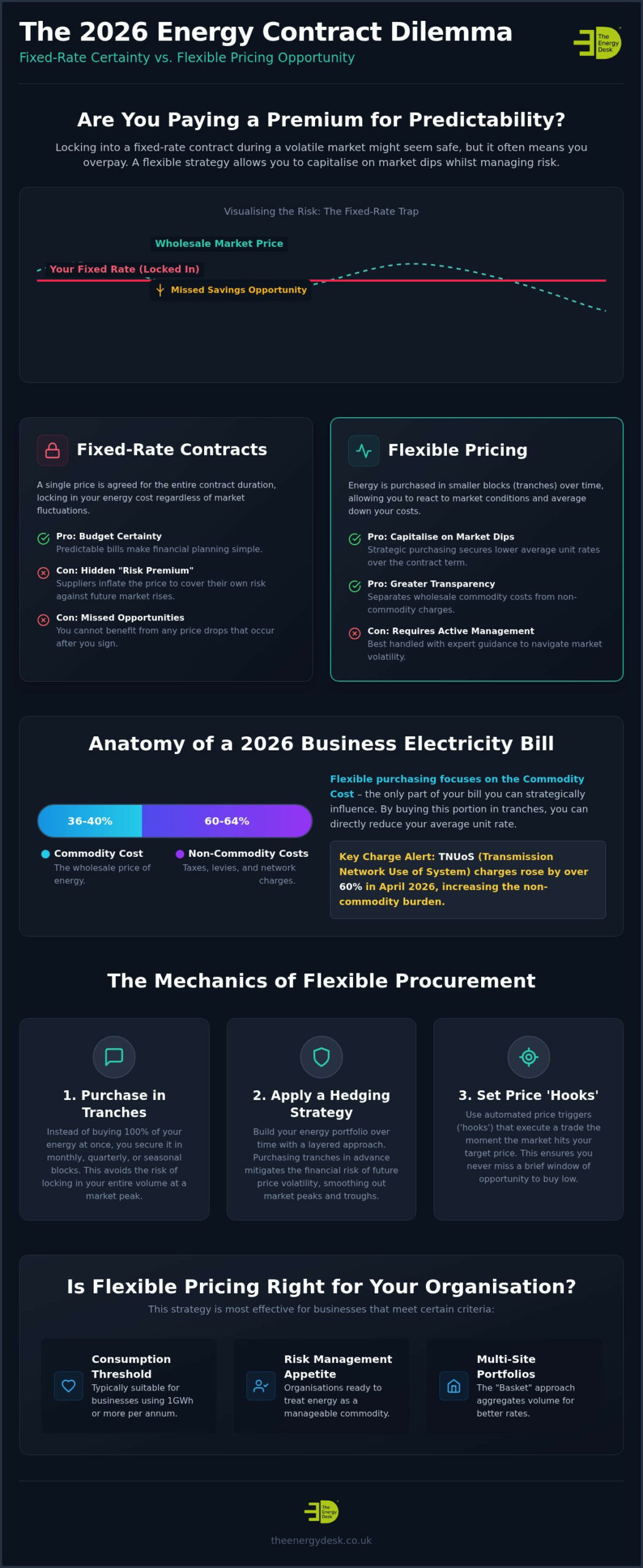
To manage energy costs effectively, you’ve got to understand what makes up your unit rate. Your bill is split into commodity costs, which is the actual energy you use, and non-commodity costs, which cover the infrastructure and regulatory levies. In 2026, non-commodity charges account for approximately 60-64% of a typical business electricity bill. These include Transmission Network Use of System (TNUoS) charges, which rose by over 60% in April 2026.
A flexible contract is designed to isolate the wholesale commodity element. Whilst non-commodity costs are largely regulated and passed through, the commodity portion is where strategic buying happens. By separating these components, businesses can focus their hedging efforts on the volatile market prices that they can actually influence through timed tranches.
The 2026 Wholesale Energy Landscape
The wholesale electricity market in August 2026 is currently experiencing renewed upward pressure. Geopolitical tensions involving Iran have reversed the downward trend seen earlier in the summer, pushing rates higher. For instance, large businesses are seeing average electricity rates around 25.0p/kWh. If you fix your price during a period of high volatility, you risk overpaying for the next three years if the market subsequently stabilises.
Timing is everything in a post-energy-crisis economy. Markets can change quickly, but a flexible framework allows you to wait for price drops before committing to your next block of power. This agility ensures you don’t miss out on savings that fixed-rate competitors simply cannot access.
The Mechanics of Flexible Purchasing: Tranches, Hedging, and Hooks
Executing a strategy for flexible business energy pricing requires moving beyond simple procurement into active trading. The process begins with buying in tranches. Instead of purchasing 100% of your energy at once, you secure blocks of power in monthly, quarterly, or seasonal segments. This avoids the risk of buying your entire annual load at a market peak. For businesses with lower individual consumption, the “Basket” approach is often used to aggregate volume with other organisations, providing the scale necessary to access the wholesale market directly.
Market execution involves balancing day-ahead buying with forward-market positions. Day-ahead purchases capture immediate spot prices, whilst forward-market buying secures long-term budget security. To manage this effectively, we set “hooks” or price triggers. These are automated instructions that execute a trade the moment the market hits a specific target price, ensuring you never miss a brief window of opportunity.
Developing a Robust Hedging Strategy
A layered hedging approach builds your energy portfolio over time, smoothing out the peaks and troughs of the wholesale market. Your specific risk appetite determines the balance. Some organisations prioritise maximum savings by staying closer to the spot market, whilst others value the security of earlier hedges. Hedging is the strategic practice of purchasing energy tranches in advance to mitigate the financial risk of future market volatility in 2026.
Market Monitoring and Execution
Successful execution depends on real-time data collection. Understanding the various factors affecting electricity prices, such as fuel supply constraints or sudden shifts in demand, allows for better-timed market entries. You can choose between a fully managed agreement, where we handle all trades, or a co-managed model where you retain final approval. To see how these mechanics apply to your specific consumption, you might consider a free energy audit to identify the most efficient structure for your organisation. Our team utilises industry data to ensure your market entries are timed for maximum fiscal advantage.
Fixed vs Flexible vs Pass-Through: A Comparative Analysis
Selecting the right energy contract involves a direct trade-off between price certainty and market opportunity. Whilst fixed-rate deals offer a static unit rate, they often include a hidden “risk premium” because the supplier assumes the volatility risk. In contrast, flexible business energy pricing transfers that control back to the business, allowing for a Total Cost of Ownership (TCO) that reflects actual market conditions rather than a supplier’s worst-case scenario forecast. Understanding these profiles is essential for any industrial or large-scale consumer aiming to protect their margins in 2026.
The TCO approach reveals that the lowest unit rate on paper doesn’t always result in the lowest final bill. A fixed contract might appear competitive, but it lacks the agility to capitalise on market downturns. A comprehensive comparison must weigh the cost of certainty against the potential savings of active procurement.
The Hidden Costs of Fixed Rate Certainty
When a supplier quotes a fixed price, they aren’t just looking at today’s wholesale rate. They add a significant buffer to protect their own margins against future spikes. If you renew during a standard window in August 2026, when geopolitical tensions have pushed electricity rates to an average of 25.0p/kWh for large users, you’re locking in that high point for the duration of the term. This creates a massive opportunity cost. If wholesale prices drop by 15% three months later, a fixed-rate business remains trapped at the peak, whilst an organisation using a flexible strategy can secure its next tranche of power at the new, lower rate.
Pass-Through Options for Large Consumers
For organisations with high annual consumption, a pass-through structure offers the highest level of transparency. This model separates the wholesale commodity cost from regulated elements like TNUoS, DUoS, and the Climate Change Levy (CCL), which stands at £0.00801 per kWh as of April 2026. By choosing a pass-through or “flex-to-pass-through” model, you avoid the additional mark-ups suppliers often apply to “fully fixed” packages to cover their own regulatory risks. Organisations managing both electricity and gas procurement can benefit from reviewing a structured approach to commercial gas tender services to ensure supplier bids are evaluated with the same rigour applied to electricity contracts.
- Transparency: You see exactly what you pay for the energy versus the grid costs.
- Control: You can choose when to hedge the commodity portion whilst the non-commodity costs follow regulated rates.
- Accuracy: Forensic bill validation is essential in this context to ensure that complex pass-through charges are calculated correctly by the supplier and reflect actual industry rates rather than erroneous estimates.
This level of granular detail is particularly beneficial for businesses that can shift their load to avoid peak DUoS and TNUoS periods, further reducing the total bill beyond simple unit rate negotiations.
Evaluating Suitability: Is Flexible Pricing Right for Your Organisation?
Whilst flexible business energy pricing offers significant advantages, it isn’t a universal solution for every commercial entity. Most suppliers set strict consumption thresholds to justify the administrative complexity of managing multiple trades. Typically, an organisation needs an annual consumption of at least 1GWh to access the full range of flexible products. For businesses below this level, the administrative costs can sometimes outweigh the wholesale savings, making a fixed-rate or “basket” deal a more pragmatic choice.
Multi-site portfolios, such as retail chains or hospitality groups, often find that flexibility simplifies their wider estate management. By aggregating the volume of dozens or hundreds of smaller sites, the group achieves the scale required for wholesale market access. This collective buying power allows for a single, cohesive procurement strategy rather than managing hundreds of individual fixed-term renewals with varying end dates.
Suitability for Industrial and Energy-Intensive Users
Manufacturing and heavy industry are the natural fits for a flexible framework. These sectors often have the operational ability to shift demand away from peak periods, which is vital for avoiding the high network charges discussed earlier. If your production schedule allows for “load-shifting” during peak DUoS windows, you can significantly reduce the non-commodity portion of your bill.
There’s also a powerful synergy between flexible gas procurement and onsite generation like CHP systems. When you generate your own power, your grid requirements fluctuate based on plant efficiency and maintenance cycles. A flexible contract allows you to adjust your purchasing tranches to account for these changes, ensuring you aren’t over-hedged when your CHP is running at full capacity. To determine if your current consumption profile matches these requirements, you can request a free energy audit to analyse your half-hourly data.
Governance and Decision-Making Requirements
Moving to a flexible model requires a shift in internal governance. Your finance or procurement team must have the mandate to make multiple buying decisions throughout the year rather than a single sign-off every two years. This is best managed through a pre-agreed Risk Management Policy (RMP). An RMP defines the “trigger points” for buying, such as maximum price ceilings or minimum volume targets, providing clear boundaries for your energy consultant to act upon.
Implementing this level of oversight ensures that decisions are based on data rather than emotion. If your organisation lacks the internal resources to monitor markets daily, a co-managed approach provides the necessary expertise whilst keeping you in control of the final budget. For more details on structuring these internal controls, you can explore our guidance on business energy portfolio management to see how we support corporate decision-making.
Optimising Your Energy Strategy with The Energy Desk
Managing flexible business energy pricing is a continuous process rather than a one-off transaction. Our expert consultants remove the administrative burden by monitoring market movements and executing tranches according to your pre-defined risk strategy. This proactive oversight ensures that your business remains agile, capturing opportunities in the wholesale market whilst maintaining the necessary fiscal safeguards. By treating energy as a strategic asset, we help you transition from passive consumption to active cost management.
The entry point for this transition is a free energy audit. We analyse your half-hourly data to determine your specific load profile and identify whether a flexible or “basket” structure is the most efficient choice for your consumption volume. This data-driven approach ensures that the contract structure you select is tailored to your operational needs rather than a generic supplier offering.
Our Procurement and Management Process
The Energy Desk follows a methodical approach from initial audit to market execution. Once a strategy is agreed, we manage the supplier tender process to secure a framework agreement that provides the necessary transparency and trading flexibility. We look beyond the unit rate, evaluating supplier service levels and the transparency of their pass-through charges to ensure no hidden costs erode your margins. For businesses that also require gas procurement support, our commercial gas tender services provide a structured checklist to expose hidden costs and evaluate supplier bids with the same methodical rigour we apply to electricity.
To support successful flexible trading, we coordinate MOP Contracts and DC/DA Services. These technical components are essential because they provide the real-time consumption data required for accurate market positioning. Without precise data, any hedging strategy remains speculative. Our team ensures your metering infrastructure is robust, providing the granular visibility needed to time your market entries with precision.
Beyond Procurement: A Strategic Alliance
Our relationship with clients extends beyond simple gas and electricity procurement. We act as a strategic ally, helping you integrate renewable infrastructure such as Solar Solutions and EV Solutions into your wider energy portfolio. This holistic approach supports long-term decarbonisation goals whilst further reducing your reliance on volatile wholesale markets. For businesses with significant heat requirements, we also provide expertise in CHP Systems to optimise onsite generation efficiency.
Accuracy is a cornerstone of our service. Our forensic bill validation and audit process is designed to catch supplier errors that often occur within complex flexible contracts. Historically, these audits have recovered significant overcharges for UK businesses, ensuring that your actual costs align perfectly with your hedged tranches. By partnering with us, you gain a methodical partner committed to your operational success and long-term fiscal responsibility. You can speak to The Energy Desk about a flexible pricing strategy for your business to begin your audit today.
Securing Fiscal Resilience in the 2026 Energy Market
Managing energy as a strategic asset is no longer optional for large-scale consumers. A sophisticated flexible business energy pricing strategy provides the agility needed to navigate the volatility of the 2026 wholesale market. It’s time to move away from the static “buy and forget” model so your organisation can avoid the hidden risk premiums of fixed contracts. By capitalising on market dips through methodical tranche purchasing, you ensure your total cost of ownership remains aligned with actual market conditions rather than supplier forecasts.
The Energy Desk has provided expert energy procurement since 2003. As an independent consultancy with access to all major UK suppliers, we simplify the complexity of hedging and market execution. We combine this strategic oversight with specialised forensic bill validation to ensure every trade is billed with absolute accuracy. Taking control of your utility strategy today protects your margins for the long term.
Request a Free Energy Audit and Flexible Pricing Review to determine the most efficient procurement structure for your load profile. Proactive management today ensures a more stable and cost-effective future for your business.
Frequently Asked Questions
What is a flexible business energy contract?
A flexible business energy contract is a procurement model that allows organisations to purchase gas and electricity in multiple stages rather than at a single point in time. This approach enables you to secure energy in monthly, quarterly, or seasonal tranches. By spreading the purchase over the duration of the contract, your business can avoid the risk of buying its entire load during a market peak, providing greater control over the final unit rate.
Is flexible energy pricing cheaper than a fixed-rate contract?
It frequently results in a lower average unit rate because it eliminates the “risk premium” that suppliers add to fixed deals to cover future volatility. Whilst a fixed rate offers budget certainty, flexible business energy pricing allows your organisation to capitalise on market downturns. By timing your trades effectively, you can outperform the static rates offered in standard fixed-term agreements, especially during periods of high wholesale price fluctuations.
What is the minimum energy consumption required for a flexible contract?
Most UK suppliers require a minimum annual consumption threshold of 1GWh (1,000,000 kWh) to access flexible procurement frameworks. This high volume is necessary to justify the administrative complexity of managing multiple tranches. However, smaller organisations with multiple sites can often achieve this threshold by aggregating their total portfolio volume into a “basket” deal, which provides the collective scale needed to trade directly on the wholesale market.
What are the risks of flexible business energy pricing?
The primary risk is exposure to wholesale market volatility. If prices rise significantly and your energy tranches haven’t been hedged in advance, your unit rates will increase accordingly. This requires a disciplined approach to risk management. Without professional oversight or a clear Risk Management Policy (RMP), a business might fail to secure energy during price dips, potentially leading to higher costs than a traditional fixed-rate contract would have provided.
How does hedging work in business energy procurement?
Hedging is the strategic process of purchasing energy tranches in advance to lock in costs for future delivery periods. By building your energy portfolio over time, you create a “layered” hedge that protects against sudden price spikes. This methodical approach allows you to secure a portion of your requirement when prices are low whilst leaving the remainder open to benefit from further market drops, balancing financial security with cost-saving opportunities.
Can I switch from a fixed to a flexible energy contract mid-term?
Switching from a fixed-rate deal to a flexible contract mid-term is generally not possible without incurring significant termination fees. Most fixed contracts are legally binding for the full term because the supplier has already purchased the energy on your behalf. The most effective strategy is to begin planning your transition to a flexible model at least six to twelve months before your current fixed-term agreement is due to expire.
What are non-commodity charges in a flexible energy bill?
Non-commodity charges are regulated costs that cover the transportation of energy and various government levies. These include Transmission Network Use of System (TNUoS) and Distribution Use of System (DUoS) charges, which facilitate grid maintenance. In 2026, these elements often account for over 60% of a typical electricity bill. Whilst the commodity price is hedged, these non-commodity elements are usually “passed through” at the regulated rates set by Ofgem and network operators.
How does The Energy Desk help manage flexible energy contracts?
The Energy Desk acts as a strategic partner by managing the complexity of market monitoring and trade execution. We utilise real-time industry data to time your market entries, ensuring every tranche is purchased in alignment with your risk appetite. Additionally, we provide forensic bill validation to verify that every complex flexible trade and pass-through charge is billed accurately by your supplier, recovering any overcharges that may occur during the contract term.