
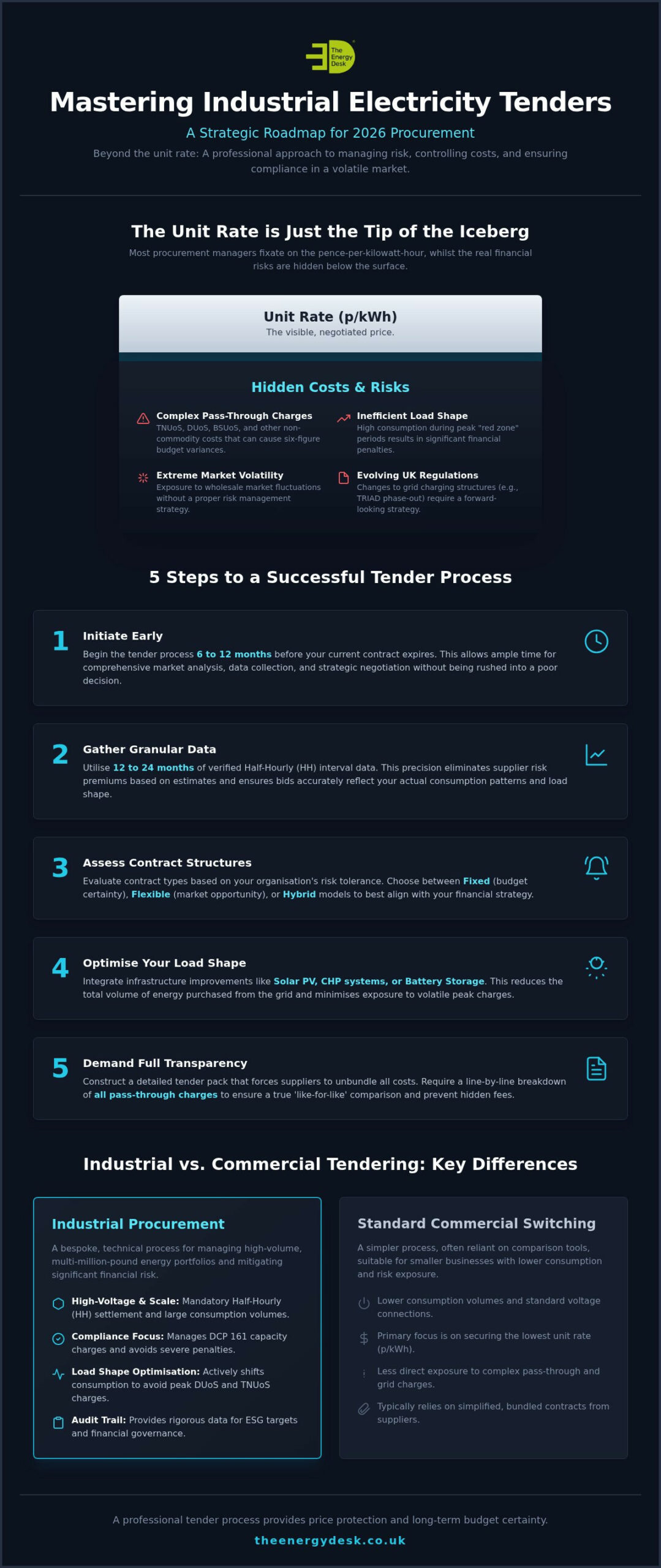
The unit rate you negotiate today is often the least important figure in your total industrial energy budget. Whilst most procurement managers fixate on the pence-per-kilowatt-hour, the real financial erosion occurs within complex pass-through charges and inefficient load shapes that go unnoticed. Managing an industrial electricity tender process for 2026 requires more than just a basic spreadsheet; it demands a strategic approach to risk that accounts for extreme market volatility and evolving UK regulatory frameworks.
It’s understandable if you feel frustrated by the time-consuming data collection required across multiple sites or the unpredictability of modern utility costs. You need price certainty for the next 12 to 36 months without being caught out by hidden fees. This guide provides a professional roadmap to mastering large-scale energy procurement. You’ll learn how to structure your tender to reduce peak charges, ensure forensic billing accuracy, and meet your corporate decarbonisation targets. We’ll examine the technical steps needed to move from reactive buying to strategic energy management, ensuring your facility remains competitive in a fluctuating market.
Key Takeaways
- Initiate the industrial electricity tender process at least 6 to 12 months before your current contract expires to allow for comprehensive market analysis and data preparation.
- Utilise 12 to 24 months of verified Half-Hourly (HH) interval data to ensure suppliers provide accurate, competitive bids based on your actual consumption patterns.
- Assess whether a fixed, flexible, or hybrid contract structure best aligns with your organisation’s risk tolerance and requirements for budget certainty.
- Integrate infrastructure improvements, such as Solar PV or CHP systems, to optimise your load shape and reduce the total volume of energy exposed to market volatility.
- Construct a detailed tender pack that requires suppliers to break down all pass-through charges, ensuring a true ‘like-for-like’ comparison across all bids.
What is an Industrial Electricity Tender and Why is it Unique?
An industrial electricity tender process is a structured, competitive framework designed to secure high-volume power supply for energy-intensive operations. Unlike standard commercial switching, which often relies on simple comparison tools, heavy industry requires a bespoke approach. It isn’t just about finding a lower unit rate; it’s about managing risk across a multi-million-pound energy portfolio. For high-volume users, the scale of procurement means that even minor fluctuations in pass-through charges can result in six-figure budget variances.
Success in this arena depends on a formal tender process that ensures every supplier bids on identical parameters. This level of transparency is essential for price protection and long-term budget certainty. As we look toward 2026, the UK energy market continues to be shaped by infrastructure updates and grid balancing costs. A disciplined strategy ensures that your facility remains operational and financially stable, regardless of external market volatility.
Industrial vs. Commercial Tendering: Key Differences
Industrial sites operate under significantly different conditions than standard retail or office spaces. Most heavy industry facilities utilise high-voltage connections and are subject to mandatory Half-Hourly (HH) settlement. This means your specific load profile dictates your costs more than the wholesale market alone. Procurement teams must manage technical complexities such as:
- DCP 161 Compliance: Managing agreed capacity to avoid significant financial penalties for exceeding supply limits.
- Transmission Charges: Navigating TNUoS and the phase-out of traditional TRIAD periods in favour of new charging structures.
- Load Shape Optimisation: Shifting consumption patterns to avoid peak DUoS (Distribution Use of System) red zones.
Why a Professional Tender is Essential for Compliance
Modern corporate governance demands total transparency in utility procurement. Financial auditors and stakeholders now expect a clear, documented audit trail that justifies how and why a specific energy contract was signed. It’s no longer enough to simply take the first offer from a broker. A professional industrial electricity tender process provides the rigorous data needed to satisfy Environmental, Social, and Governance (ESG) targets. It also prevents the catastrophic costs associated with ‘out-of-contract’ rates, which can be double or triple the standard market price during a transition period.
The Technical Foundation: Data Requirements for a Successful Tender
Precision is the most valuable currency in energy procurement. An industrial electricity tender process built on estimated annual consumption (EAC) will inevitably lead to inflated risk premiums. Suppliers apply these financial buffers to protect themselves against the unknown. To secure the most competitive rates, you must provide 12 to 24 months of Half-Hourly (HH) interval data. This granular view allows bidders to see exactly when your facility draws power, distinguishing between your steady base load and your volatile peak demand periods.
You’ll need a signed Letter of Authority (LOA) to access this data efficiently. This document empowers your consultant to liaise directly with your current supplier and meter operator. It’s the first step in a professional energy audit to ensure no data gaps exist before the tender goes live. Without this technical foundation, suppliers cannot accurately price your specific load shape, often resulting in “worst-case scenario” pricing that damages your bottom line.
Understanding MOP, DC, and DA Services
Many industrial firms mistakenly leave their Meter Operator (MOP) and Data Collection (DC) services bundled within their supply contract. This is often a missed opportunity for cost reduction. Tendering your MOP contract separately allows you to choose a provider that offers better technical support and lower annual fees. Similarly, independent Data Collection and Data Aggregation (DA) services ensure your billing is based on actual reads rather than estimates. This accuracy is critical for the procurement of renewable resources and managing complex site infrastructure where every kilowatt counts.
Contestable vs. Non-Contestable Costs
Your total electricity bill is split into two distinct categories. Non-contestable costs include regulated pass-throughs such as DUoS (Distribution Use of System), TNUoS (Transmission Network Use of System), and statutory levies like the Renewables Obligation (RO) or Contracts for Difference (CfD). These are set by the regulator and the government, meaning every supplier will charge the same amount for these elements. Contestable costs are the portion of the bill where suppliers actually compete. By focusing your industrial electricity tender process on this specific segment, you can pressure suppliers to reduce their margins whilst maintaining full visibility over the unavoidable network charges that will impact your 2026 budget.
Evaluating Contract Structures: Fixed, Flexible, or Hybrid?
Selecting the right contract structure is the most critical decision in the industrial electricity tender process. It dictates how your business interacts with wholesale market volatility and determines your level of financial exposure. A mismatch between your contract type and your business’s risk appetite can lead to significant budget overruns or missed opportunities for savings during market dips.
Fixed-price contracts remain a popular choice for organisations prioritising absolute budget certainty. By locking in a unit rate for 12 to 36 months, you eliminate the risk of sudden price spikes. However, this stability comes at a cost, as suppliers often include a risk premium in their quotes. If the market drops after you’ve signed, you’re stuck with the higher rate. Conversely, flexible procurement allows you to purchase energy in ‘tranches’ throughout the contract term. This strategy enables you to leverage market downturns by buying when prices are low, though it requires a more hands-on approach to management. Understanding the full scope of business electricity contract negotiation is essential before committing to any structure, as the terms you agree today will shape your financial exposure for years to come.
Risk Management in Industrial Procurement
Flexible contracts are powerful tools, but they require rigorous oversight to be effective. Implementing ‘stop-loss’ triggers is essential to protect your budget. These are pre-defined price points that, if reached, trigger an automatic purchase to prevent further exposure to a rising market. Most industrial firms lack the internal resources to monitor wholesale movements 24/7. This is where a strategic ally becomes vital, as they can track market signals and execute trades on your behalf. Utilising a structured Department of Energy procurement framework helps in defining these risk parameters clearly before the tender begins.
The ‘Basket’ Tendering Approach
For businesses with multiple facilities, a ‘basket’ or portfolio approach is often the most efficient strategy. Instead of tendering sites individually, you combine your total volume to increase your leverage with suppliers. This larger ‘pot’ of energy is more attractive to bidders, often resulting in tighter margins and better service level agreements. A unified strategy also allows you to:
- Standardise contract end dates: Aligning all sites to a single renewal date simplifies administration and future tendering.
- Simplify billing: Consolidated billing reduces the administrative burden on your finance department.
- Optimise group load: Balancing high-demand sites with lower-use facilities can improve your overall group load shape, making the portfolio more desirable to suppliers.
The Step-by-Step Industrial Electricity Tender Process
A successful industrial electricity tender process begins long before your current contract expires. You should ideally initiate the preparation phase 6 to 12 months in advance. This lead time is necessary to account for market fluctuations and to gather the technical documentation required for a robust tender pack. A rushed tender often results in limited supplier engagement and higher risk premiums. By starting early, you position your organisation to act when market conditions are most favourable rather than being forced to sign during a price spike.
Phase 1: Audit and Data Validation
Before approaching the market, you must establish an accurate baseline through a comprehensive data review. This starts with forensic bill validation to identify and recover historical overcharges. Forensic validation must precede the tender because it ensures the consumption data sent to suppliers is accurate and reflects your true operational needs. It also identifies billing errors that, if left uncorrected, would be carried over into your new contract. You can book a free energy audit to begin this validation process and uncover immediate efficiency gains that reduce your required tender volume.
Your tender pack is the foundation of your procurement exercise. It must include your full site list, MPAN details, and at least 12 months of Half-Hourly data. To ensure you aren’t comparing apples with oranges, you must specify exactly which pass-through charges should be included or excluded from the unit rate. Don’t limit your search to the ‘Big Six’ suppliers. Specialist industrial providers often offer more flexible terms and better customer service for high-voltage users; for instance, you can explore commission-based energy sales brokerage and technical project fees at Doradcy Energetyczni to see how these consultancy models are structured in other major European energy markets.
Phase 2: Running the Tender and Evaluating Bids
Once your data is clean, you issue a formal Request for Proposal (RFP) to a pre-qualified panel of suppliers. During the tender window, expect technical queries regarding your site infrastructure or future load changes. Managing these centrally ensures all bidders receive the same information, maintaining the integrity of the industrial electricity tender process.
Evaluating the responses requires more than just looking at the bottom line. Use a weighted scoring matrix to rank bids based on several critical factors:
- Price competitiveness: Normalised to account for varying pass-through assumptions.
- Service levels: Account management reputation and billing accuracy.
- Green credentials: Alignment with your corporate ESG and decarbonisation targets.
- Financial stability: Ensuring the supplier can withstand long-term market volatility.
The final stage involves a meticulous review of the contract’s terms and conditions before signing. Once executed, the onboarding phase begins. This includes setting up Data Collection (DC) services and ensuring a seamless handover between suppliers to avoid expensive out-of-contract rates during the transition.
Optimising Your Tender: Integrating Renewables and Infrastructure
The most effective way to protect your business from market volatility isn’t just about finding a better rate; it’s about reducing the volume of energy you need to buy from the grid. Integrating onsite generation into your industrial electricity tender process fundamentally changes your risk profile. When you generate a portion of your own power, you’re no longer fully exposed to the fluctuations of the wholesale market or the rising costs of network pass-through charges.
The Role of Onsite Solar and CHP
Onsite Solar PV installations allow industrial facilities to offset high-cost peak-time electricity. This “peak shaving” is particularly valuable under 2026 charging structures, where red-zone DUoS charges can significantly inflate operational costs. For heat-intensive sectors like food processing or chemical manufacturing, Combined Heat and Power (CHP) systems offer a dual benefit. By capturing waste heat to use in industrial processes, a CHP system delivers thermal efficiency that a grid-only supply cannot match. These infrastructure investments don’t just lower your carbon footprint; they provide the technical leverage needed to negotiate better terms for your remaining grid-supplied volume.
Looking ahead to 2026, Corporate Power Purchase Agreements (CPPAs) are becoming a standard component of industrial energy strategies. These agreements allow you to lock in a long-term price for renewable energy directly from a generator, providing unparalleled price stability. Additionally, your procurement strategy must account for the increasing demand of industrial EV fleet charging. Failing to factor in these future load requirements during your current tender can lead to expensive capacity upgrades later.
How The Energy Desk Manages Your Industrial Tender
At The Energy Desk, we operate as a strategic ally rather than a simple broker. Our independent, consultative approach ensures your procurement strategy is aligned with your specific operational needs and infrastructure goals. We manage the entire lifecycle of the industrial electricity tender process, from the initial data collection to the final contract execution. Our expertise allows us to navigate the complexities of the UK market whilst you maintain focus on your core manufacturing or production activities.
Our team provides an end-to-end service that includes forensic bill validation to recover historical overcharges and the management of complex utility connections for new infrastructure. We ensure that every aspect of your energy management, including MOP and DC/DA contracts, is optimised for maximum cost-efficiency. To see how we can help your facility secure a more resilient energy future, contact The Energy Desk today for a free industrial energy audit. This initial assessment serves as the technical foundation for a tender that delivers genuine, long-term value.
Securing Your Industrial Energy Future
Managing your energy portfolio for 2026 requires a shift from reactive switching to proactive risk management. Success in the industrial electricity tender process depends on three core pillars: technical data accuracy, a disciplined procurement strategy, and the integration of modern infrastructure like CHP or Solar PV. By validating your historical billing and optimising your load shape today, you protect your facility against the volatile network charges and market shifts expected in the coming years. This methodical approach ensures that your utility costs remain a controlled variable rather than a source of budget unpredictability.
The Energy Desk has operated as an independent UK-wide consultancy since 2003, providing the technical oversight needed to navigate these complexities. Our team specialises in forensic bill validation to recover overcharges and the seamless integration of renewable solutions to lower your grid dependency. We’re ready to help you transform your energy procurement into a lasting strategic advantage. Request your free industrial energy audit and tender consultation to start building a more resilient and cost-effective energy strategy for your business.
Frequently Asked Questions
How long does a typical industrial electricity tender process take?
A typical industrial electricity tender process requires six to twelve months of lead time before your current contract expires. This extended period allows for rigorous data validation, site audits, and comprehensive market analysis. The actual bidding window usually spans four to six weeks; however, the preparation phase is critical for ensuring the accuracy of your tender pack. Starting early prevents the risk of being forced into a contract during a period of high volatility.
Can I tender my electricity and gas together in a single process?
You can certainly tender your electricity and gas requirements simultaneously to leverage your total energy spend. This approach often increases your appeal to suppliers, potentially resulting in more competitive management fees. It also simplifies your administrative burden by aligning renewal dates and streamlining communication with a single consultancy. However, each utility will still require separate technical analysis due to the different market drivers affecting gas and power prices.
What is the difference between a broker and an energy procurement consultant?
An energy procurement consultant acts as a strategic ally, offering long-term risk management and technical oversight rather than just a simple price comparison. Whilst brokers often focus on the immediate transaction and unit rate, a consultant integrates forensic bill validation and infrastructure advice. This professional approach ensures your energy strategy aligns with corporate objectives, such as decarbonisation targets and long-term budget stability, rather than just seeking a quick, superficial fix.
What happens if I don’t run a tender before my contract expires?
If you fail to secure a new contract before your current one ends, your supplier will move you onto out-of-contract or ‘deemed’ rates. These rates are significantly higher than negotiated contract prices, sometimes doubling your monthly expenditure. Additionally, you lose the ability to manage your load shape effectively or protect your budget against wholesale price spikes. Reverting to these rates can cause immediate and severe damage to your facility’s operational budget.
How do I know if a flexible electricity contract is right for my factory?
Flexible contracts are typically suitable for high-volume users who can tolerate some market exposure in exchange for potential savings. If your factory has the operational flexibility to shift load or the financial capacity to manage some variance, a flexible structure allows you to buy energy in tranches. This strategy is ideal for businesses that want to avoid the risk premium often baked into fixed-price quotes by suppliers during volatile market periods.
Are green energy tariffs more expensive for industrial users in 2026?
Green energy tariffs are no longer prohibitively expensive, and in many cases, they’re price-competitive with standard brown power. The narrowing price gap is driven by increased renewable capacity and the rising cost of carbon for fossil-fuel generation. For many industrial firms, the primary benefit of a green tariff is meeting ESG requirements and avoiding future environmental levies. Corporate Power Purchase Agreements also offer long-term price stability for renewable energy.
What are pass-through costs and can they be negotiated in a tender?
Pass-through costs are regulated charges for using the electricity network, such as DUoS and TNUoS, which are non-negotiable as they’re set by the regulator. Whilst the rates themselves are fixed, a professional industrial electricity tender process helps you identify how to minimise these charges through load shifting. By understanding your red-zone consumption and agreed capacity, you can reduce the total amount you pay, even if the underlying rates remain static.
How does Half-Hourly (HH) metering affect my tendering options?
Half-Hourly metering is mandatory for high-volume industrial sites and provides the granular data suppliers need to offer bespoke pricing. This data allows you to prove your actual consumption patterns, which can lead to lower risk premiums from bidders. HH data also enables more sophisticated tendering options, such as flexible procurement and specific peak-shaving strategies. Without this level of detail, you’d be limited to generic, often more expensive, profile-based contracts.