


Treating a commercial gas meter relocation as a minor maintenance task is a strategic error that often leads to weeks of unplanned operational downtime. You likely understand that moving utility infrastructure is complex, but the reality involves a fragmented web of Gas Distribution Networks (GDNs), Meter Asset Managers (MAMs), and strict IGEM safety standards. It’s a process where a single oversight in the 48-hour notice period or a misunderstanding of pipework ownership can result in significant, unexpected costs that eat into your margins.
This guide provides the definitive framework for managing your relocation project efficiently. You’ll learn how to navigate the regulatory landscape and synchronise multiple stakeholders to ensure your business remains fully operational throughout the transition. We will outline a clear project timeline, explain how to maintain compliance with current Gas Safety Regulations, and reveal strategies to minimise infrastructure expenses through forensic bill validation and strategic MAM selection.
Key Takeaways
- Define the critical distinction between Gas Distribution Networks and Meter Asset Managers to ensure project responsibilities are correctly assigned from the outset.
- Identify the primary technical factors, such as pipe diameter and distance from the gas main, that dictate the total investment required for a commercial gas meter relocation.
- Master a structured project management approach, beginning with a professional load assessment, to eliminate the risk of unexpected supply disconnections.
- Leverage infrastructure projects as a strategic opportunity to conduct forensic bill validation and recover historical utility overcharges.
- Streamline complex multi-party communications by appointing a dedicated partner to handle GDN and supplier liaison so you don’t have to manage the technical minutiae yourself.
Understanding Commercial Gas Meter Relocation Requirements
Commercial gas meter relocation involves the physical displacement of the primary fiscal meter and the associated “upstream” pipework from its current position to a new, more suitable location on a site. It is a technical infrastructure project that goes far beyond a simple plumbing adjustment. This process requires re-engineering the connection between the Gas Distribution Network (GDN) and your facility to ensure the supply remains safe and compliant. Businesses often find that as their operations evolve, the original placement of utility infrastructure becomes a literal barrier to growth or safety.
The choice between internal and external relocation depends largely on your facility’s layout and operational needs. Industrial units frequently move meters to external kiosks to reclaim valuable internal floor space for production or storage. Conversely, some sites require internal moves to protect sensitive metering equipment from harsh environmental conditions or potential vehicle impact in busy loading bays. Every move demands bespoke engineering to account for the specific flow rates and pressures required by commercial machinery.
When is Relocation Essential for Your Business?
Operational growth is the most common driver. If you are installing high-capacity machinery or expanding your facility, your current meter may sit directly in the footprint of a planned extension. Relocation becomes essential when existing infrastructure fails to meet updated safety distances from buildings, thoroughfares, or ignition sources. Moving the meter also provides a strategic opportunity to accommodate increased peak load requirements. By repositioning the connection point, you can simultaneously upgrade the capacity of your supply to prevent pressure drops that might otherwise stall your production lines during peak periods.
Commercial vs. Domestic Meter Moves
Industrial projects differ significantly from domestic “meter flips” due to the hardware involved. The technical foundation of how gas meters work varies across scales; while small businesses might use standard diaphragm meters, larger industrial sites rely on heavy-duty rotary or turbine meters to handle high-volume flows accurately. These units require substantial civil works, including reinforced concrete pads and high-specification security housing to withstand industrial environments.
Safety protocols are also more stringent. The Emergency Control Valve (ECV) is the primary safety mechanism situated at the end of the service pipe that allows the gas supply to be manually isolated from the premises during an emergency. In a commercial setting, the ECV must remain immediately accessible to staff and emergency services at all times. Because of this, the relocation strategy is often dictated by the need to maintain a clear, unobstructed path to this valve, regardless of how the rest of the site is developed.
The Regulatory Framework: GDNs, Suppliers, and MAMs
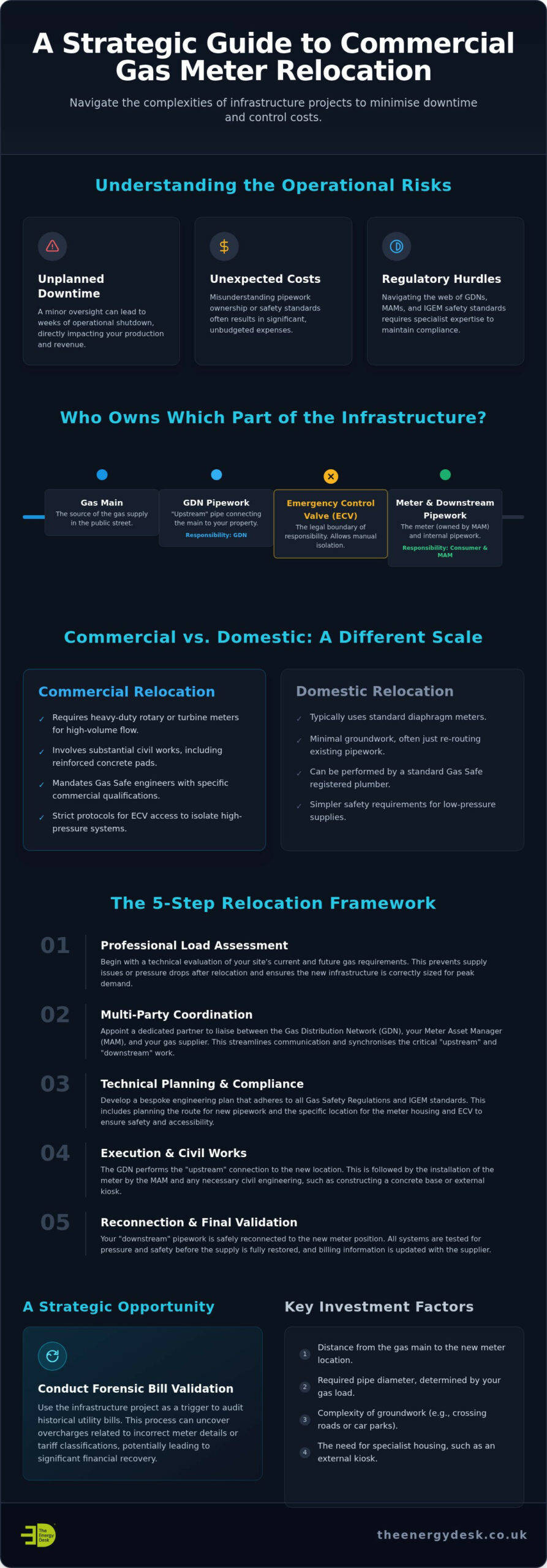
A commercial gas meter relocation is governed by a strict hierarchy of responsibilities. It is not a single-task project but a tripartite operation that requires precise timing. The Gas Distribution Network (GDN) manages the “upstream” work, which involves moving the service pipe that connects the gas main to your property. Once the pipe is in place, the Meter Asset Manager (MAM) takes over to install or move the physical meter unit. Finally, your gas supplier ensures the “downstream” pipework is reconnected and that your billing data is accurately updated in the national database.
Compliance is non-negotiable. All work must adhere to the Gas Safety (Installation and Use) Regulations 1998 and the latest IGEM standards. While specific UK standards govern local technicalities, the broader federal regulatory framework seen in international energy markets highlights the critical nature of pipeline and facility oversight for industrial safety. For organisations prioritising comprehensive risk management during these transitions, Vita Secure offers professional safety services to ensure all works are conducted within a secure framework. Failure to follow these protocols doesn’t just risk a fine; it can lead to the immediate disconnection of your supply by the network operator.
Who Owns Which Part of the Infrastructure?
The Emergency Control Valve (ECV) serves as the legal boundary of responsibility. Everything up to and including the ECV belongs to the GDN; everything after it is the consumer’s responsibility, though the physical meter is typically managed by the MAM. Because of this complexity, you cannot hire a standard domestic plumber for these works. Commercial meter moves require Gas Safe registered engineers who hold specific commercial “tickets” to work on high-pressure systems and large-scale meters. These specialists ensure that the relocated infrastructure can handle the specific load requirements of your industrial equipment without compromising the integrity of the wider network.
Coordinating Multiple Stakeholders
The primary challenge in any commercial gas meter relocation is synchronisation. If the GDN completes the pipework but the MAM technician doesn’t arrive to install the meter, your business is left with a “dead” supply. This lack of coordination often leads to significant operational downtime and “out of contract” billing errors if the meter serial numbers aren’t updated correctly in the central registry.
Understanding your Meter Operator (MOP) Contracts Guide is essential for managing these technical relationships. Effective project management involves aligning these disparate parties into a single, cohesive timeline. If you find the prospect of managing multiple utility contractors daunting, you may benefit from professional utility connection assistance to handle the GDN and MAM liaison on your behalf.
Assessing Relocation Complexity and Potential Costs
Every commercial gas meter relocation is unique. Costs are primarily dictated by technical variables rather than flat fees. The distance from the gas main is a major factor, as the Gas Distribution Network (GDN) typically charges based on the length of new service pipe required. Pipe diameter is equally critical; industrial-scale meters require larger bore piping to maintain pressure and volume. Ground conditions also play a pivotal role. If your site requires excavation through reinforced concrete or needs complex traffic management to facilitate work near a public highway, the civil engineering costs will rise significantly.
Because these projects often involve a temporary disconnection, they provide a logical window to review your business gas procurement strategy. Ensuring your new infrastructure is paired with the most efficient tariff can help offset the initial capital expenditure of the move.
Standard vs. Complex Commercial Moves
A “Standard” move generally refers to relocations within the same room or on the same wall, usually involving less than one metre of new pipework. These projects are relatively straightforward but still require professional oversight. Complexity increases when you relocate the meter to a different building or across a larger industrial site. Such moves often require a reassessment of peak flow rates. If your business has expanded, the relocation is the ideal time to ensure your new pipework specifications meet the high-volume demands of modern machinery. All technical adjustments must strictly follow UK gas meter regulations to ensure the meter remains a legal fiscal instrument.
Complex moves often involve several key technical factors:
- Site Reinstatement: The cost of returning the ground to its original state after trenching.
- Pressure Requirements: The need for additional boosters or regulators if the meter is moved further from the source.
- Housing Specifications: The requirement for bespoke external kiosks or fire-rated internal rooms.
Hidden Costs and How to Avoid Them
Unexpected expenses often arise from poor site preparation. “Abortive visit” fees are common when the GDN or MAM arrives to find the site isn’t ready for excavation or access is blocked. To prevent daytime shutdowns, many firms opt for “out of hours” work. This carries a premium but protects operational continuity, which is often more cost-effective for high-output facilities. You should also consider how relocation affects your standing charges. A change in meter capacity or pipe diameter can lead to adjustments in your daily fixed costs or KVA allowances, which should be validated against your bills immediately after the project completes.
Step-by-Step Project Management for Meter Relocation
Executing a successful commercial gas meter relocation requires a disciplined approach to project management. It’s not merely a physical move; it’s a sequence of technical and legal milestones that must be met to ensure safety and continuity. The process begins with a comprehensive site survey and load requirement assessment. This stage is vital to determine if your existing supply capacity can support your future operational needs or if the relocation should trigger a capacity upgrade.
Once the technical specifications are defined, the second step involves obtaining and comparing quotes. While the GDN owns the regional infrastructure, independent providers can often offer more flexible project management timelines. The third stage focuses on compliance, specifically managing legal and safety documentation such as G17 design and PS5 technical audits. Finally, the physical move is executed. This requires the precise synchronisation of the “re-live” process, where the old supply is decommissioned and the new connection is commissioned under strict supervision.
If you require support with the technical tendering process, you can access expert utility connection assistance to ensure you receive competitive and accurate quotes for your infrastructure works.
Minimising Operational Downtime
For industrial facilities, even a few hours of lost production can be financially damaging. We recommend scheduling relocation works during seasonal lows or during planned maintenance shutdowns to mitigate this risk. In cases where a continuous supply is non-negotiable, temporary bypasses can be installed to keep critical processes running whilst the primary meter is moved. Once the new connection is established, engineers perform a “purge and relight” process, which involves systematically removing air from the pipework and verifying that every gas-fired appliance on the site is functioning safely and efficiently.
Post-Relocation: Billing and Data Accuracy
The project doesn’t end when the gas starts flowing. You must ensure that your Meter Point Reference Number (MPRN) and administration records are updated in the national database to reflect the new meter’s serial number and location. Failure to do this often results in “estimated” billing or data gaps in your energy management platform. It’s also essential to verify that smart meter data continues to flow correctly to your monitoring software. We advise conducting a thorough commercial utility bill validation immediately after relocation to catch and correct any discrepancies in your standing charges or consumption data before they impact your bottom line.
Strategic Utility Management with The Energy Desk
The Energy Desk serves as a strategic ally for businesses facing the logistical hurdles of a commercial gas meter relocation. Managing multiple utility contractors while maintaining production is a significant burden for any internal team. By acting as a single point of contact, we oversee the entire project lifecycle, from initial GDN engagement to the final MAM commissioning. This methodical oversight ensures that technical specifications are met without the typical delays associated with fragmented communication. We understand that infrastructure changes are not just technical tasks but financial ones that impact your bottom line for years to come.
Our approach extends beyond simple infrastructure work. We integrate every relocation project into a broader energy risk management strategy. This ensures that your physical assets align with your long-term fiscal objectives. During site transitions, businesses are particularly vulnerable to administrative errors. We provide support to protect your company from out of contract energy rates, which often occur when meter serial numbers are updated incorrectly in central databases. A free energy audit during this phase identifies inefficiencies that might otherwise remain hidden during the upheaval of a site move.
End-to-End Infrastructure Support
We handle the technical liaison with GDNs and MAMs, allowing your senior management to focus on core operations. Our consultants ensure that every new connection is not just a replacement but an optimisation. We evaluate your current setup for future renewable energy integration, such as hydrogen-blend readiness or heat pump compatibility. Additionally, our team specialises in identifying historical overcharges. Meter exchanges are a common trigger for billing anomalies. We use this transition period to conduct a forensic audit, often recovering significant sums for our clients by identifying errors in previous standing charges or unit rates.
Contact Our Expert Team Today
A holistic approach to utility management is essential for modern cost control. We provide integrated solutions across gas, electricity, and water, ensuring that your infrastructure supports your operational efficiency. Whether you are expanding a single site or managing a national portfolio, our expertise ensures precision and fiscal responsibility. Our proactive mindset means we anticipate bottlenecks before they impact your timeline or budget.
Request a bespoke quote for your commercial gas infrastructure works to ensure your project is managed by seasoned professionals. Contact The Energy Desk on 03330 151 221 for expert guidance and to arrange your comprehensive utility review.
Securing Operational Continuity through Professional Oversight
A successful commercial gas meter relocation requires more than technical execution; it demands strategic foresight and precise multi-stakeholder management. By synchronising the efforts of Gas Distribution Networks and Meter Asset Managers, you can avoid the common pitfalls of operational downtime and administrative billing errors. This transition serves as a vital opportunity to audit historical consumption and validate your utility infrastructure for future growth.
Since 2003, The Energy Desk has provided independent consultancy and national UK coverage for businesses in all industrial sectors. We manage the end-to-end liaison with GDNs and MAMs, ensuring your project remains compliant with current standards whilst protecting your margins. Our team delivers a seamless transition that safeguards your business from out-of-contract rates and unnecessary costs.
Request a Free Commercial Energy Audit and Infrastructure Review today to ensure your project is managed with professional precision. We look forward to helping you optimise your utility connections and secure long-term efficiency.
Frequently Asked Questions
How much does it cost to move a commercial gas meter in the UK?
The investment for a commercial gas meter relocation is determined by technical complexity rather than a fixed fee. Factors include the distance from the gas main; the pipe diameter required for your load; and the extent of civil works such as trenching and reinstatement. Whilst industry averages often sit around £1,000; complex industrial projects requiring high-pressure specifications can exceed £1,500. It’s essential to obtain separate quotes for the GDN service work and the MAM meter installation.
How long does the commercial gas meter relocation process take?
The commercial gas meter relocation process typically requires a lead time of between 6 and 14 weeks from the initial application to project completion. This duration accounts for site surveys; the 48-hour statutory notice period required by the Gas Act 1986; and the coordination of multiple utility contractors. Starting the process early is critical to ensure that infrastructure changes don’t conflict with your planned site developments or seasonal production peaks.
Do I need to inform my gas supplier before moving my meter?
You must notify your gas supplier before any work commences. Under the Gas Act 1986; the gas supplier or transporter requires at least 48 hours’ notice before a meter is disconnected or moved. Failure to provide this notice can lead to billing errors or legal complications. Your supplier will also need to update the national database with the new meter details to ensure your consumption data remains accurate and to prevent estimated billing.
Can I move my commercial gas meter myself if I am Gas Safe registered?
It is illegal for a property owner or an unauthorised person to move a fiscal gas meter; even if they are Gas Safe registered. All work on the “upstream” service pipe must be performed by the regional Gas Distribution Network. The physical meter move must be executed by a registered Meter Asset Manager (MAM). Only these authorised entities have the legal right to break the meter seals and modify the network connection.
What is the difference between a GDN and a MAM in the relocation process?
The Gas Distribution Network (GDN) owns and operates the infrastructure that brings gas to your site; including the service pipe and the Emergency Control Valve. The Meter Asset Manager (MAM) is responsible for the physical meter unit and its maintenance. For a relocation; the GDN moves the incoming pipework whilst the MAM disconnects and reinstalls the meter itself. Coordinating these two parties is essential for a seamless “re-live” process.
Will my gas supply be cut off during the meter relocation?
Yes; your gas supply will be temporarily disconnected during the relocation to ensure safety whilst pipework is modified. For businesses with critical industrial processes; engineers can often install a temporary bypass to maintain a limited supply. Once the move is complete; a “purge and relight” procedure is carried out to remove air from the system and verify that all appliances are functioning correctly before the site returns to full operation.
Do I need a new gas contract if I move my meter to a different part of the site?
You don’t usually require a new gas contract simply because you have moved your meter to a different part of the same site. However; you must ensure that your Meter Point Reference Number (MPRN) records are accurately updated to reflect the change. This is the ideal time to perform a procurement review. Ensuring your new meter is paired with a strategic contract can protect you from out-of-contract rates during the transition period.
What are the safety distance requirements for relocating an industrial gas meter?
Relocating an industrial gas meter requires strict adherence to IGEM standards and British Standards such as BS 6400-1. These regulations specify minimum distances from building openings; thoroughfares; and potential ignition sources. Meters must be housed in ventilated; fire-rated kiosks or dedicated internal rooms that provide easy access for emergency services. The Emergency Control Valve (ECV) must remain unobstructed at all times to ensure the supply can be isolated quickly in an emergency.