

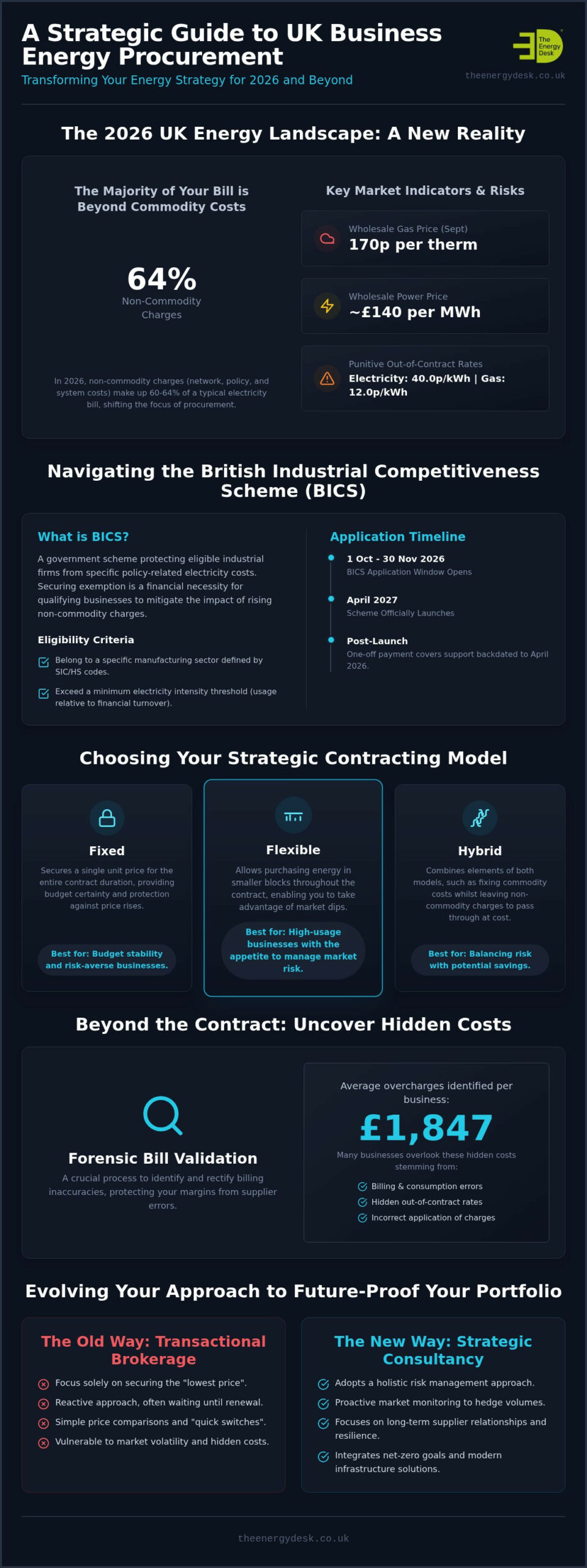
Did you know that in 2026, non-commodity charges now account for between 60% and 64% of a typical electricity bill? This shift has fundamentally changed business energy procurement UK, meaning the majority of what you pay is now dictated by complex network and policy costs rather than just the wholesale price of power.
You’re likely feeling the strain as market volatility impacts your margins, particularly with wholesale gas prices reaching 170p per therm this September. Navigating the shifting regulatory landscape whilst managing carbon reporting and BICS compliance can be exhausting, especially when hidden out-of-contract rates and billing errors go unnoticed.
This guide will help you transform your energy strategy from a simple transaction into a strategic advantage. You’ll learn how to secure long-term price stability and develop a clear roadmap for both net-zero and the upcoming British Industrial Competitiveness Scheme.
We’ll analyse the latest 2026 market trends, the impact of Market-wide Half-Hourly Settlement, and how forensic validation identifies the average £1,847 in overcharges that many businesses currently overlook.
Key Takeaways
- Learn how to transform business energy procurement UK from a transactional expense into a strategic advantage by adopting a holistic risk management approach.
- Gain clarity on how the British Industrial Competitiveness Scheme (BICS) and shifting non-commodity charges will redefine your energy budget for the 2026 period.
- Compare fixed, flexible, and hybrid contracting models to determine which structure best aligns with your operational goals and risk appetite.
- Identify the common billing errors and forensic validation techniques required to protect your margins from hidden costs and supplier inaccuracies.
- Explore how to future-proof your utility portfolio by transitioning from traditional brokerage to a strategic consultancy partnership that integrates modern infrastructure solutions.
The Landscape of Business Energy Procurement in the UK (2026)
Effective business energy procurement UK is the methodical acquisition of commercial gas and electricity contracts. It’s no longer a transactional “lowest price” exercise. Instead, it’s a holistic management strategy. In 2026, the landscape is shaped by three primary drivers: geopolitical stability affecting gas imports, significant grid infrastructure updates, and the accelerating pace of industrial decarbonisation. These factors mean that energy is now a boardroom-level risk that requires constant oversight.
Failing to manage this process leads to punitive out-of-contract rates. Current market data shows electricity out-of-contract rates at 40.0p per kWh and gas at 12.0p per kWh. For a high-usage site, these rates can erode annual margins in weeks. Strategic procurement ensures you aren’t left exposed when a contract expires. It’s about securing a position before the market moves against you.
Market Volatility and the 2026 Energy Outlook
While the extreme spikes of the early 2020s have subsided, UK energy prices remain historically high. Wholesale power is trading near £140/MWh, and gas has risen to approximately 170p/therm as of September 2026. Timing your market entry is now the difference between profit and loss. You can’t simply wait for a renewal date; you must monitor market dips months in advance. Implementing professional business energy portfolio management allows firms to hedge volumes when prices are favourable, mitigating the risk of sudden spikes. This proactive approach is essential when non-commodity costs, such as TNUoS charges which rose by 60% this year, make up the bulk of your bill.
Defining Strategic Procurement in a Post-Crisis Era
We’ve moved past the era of “quick switches”. Modern business energy procurement UK focuses on long-term supplier relationship management and operational resilience. This is particularly relevant for sectors following the lead of central purchasing bodies, where aggregated volume and structured frameworks provide stability. Approximately 29% of businesses switched suppliers in the last year, but many did so without a long-term plan.
A strategic partner does more than find prices. They navigate increasingly stringent supplier credit requirements and ensure your business remains an attractive prospect for energy providers. The goal isn’t just finding the cheapest unit; it’s about building a resilient energy infrastructure. This involves a disciplined, analytical approach to contract terms and a forward-thinking perspective on fiscal responsibility. By moving from a reactive to a proactive stance, you protect your bottom line from the unpredictability of the 2026 market.
Navigating the British Industrial Competitiveness Scheme (BICS)
The British Industrial Competitiveness Scheme (BICS) is a critical pillar of business energy procurement UK for 2026. BICS is a mechanism to protect UK industrial competitiveness by exempting eligible firms from specific policy-related electricity costs. For industrial users, this scheme is the most direct way to mitigate the rising non-commodity charges that now dominate commercial bills. Because these charges comprise over 60% of an average electricity bill in 2026, securing an exemption isn’t just a bonus; it’s a financial necessity.
The application window for BICS opens on 1 October 2026 and runs until 30 November 2026. Businesses that successfully apply will see the scheme officially launch in April 2027, with a one-off payment to cover support backdated to April 2026. This makes the current procurement cycle vital for long-term fiscal planning. While Ofgem’s advice for businesses provides a foundational understanding of contract standards, navigating the technicalities of BICS requires a more forensic approach to data management.
BICS Compliance and Financial Eligibility
Eligibility is strictly defined by SIC codes for manufacturing sectors and specific HS codes for products. Beyond sector classification, businesses must also exceed a minimum electricity intensity threshold to qualify for support. Procurement teams are now tasked with managing complex reporting obligations, which include providing detailed evidence of energy usage relative to financial turnover. Strategic consultants play a pivotal role here, gathering the necessary meter data and production statistics to ensure applications are robust before the November deadline. Missing this window could leave a manufacturer exposed to significantly higher overheads than their competitors.
Strategic Integration of BICS into Energy Tenders
Understanding your BICS status allows for more precise forecasting during the business energy procurement UK process. When you approach suppliers for new contracts, demonstrating your eligibility for these exemptions can lead to more competitive terms, as it reduces the perceived risk and total cost of your account. Data transparency is essential throughout the tender to ensure suppliers apply these exemptions correctly from the start. For those in heavy industry, our business gas procurement guide offers specific insights into how these electricity schemes interact with broader fuel strategies. To ensure your data meets the strict 2026 thresholds, consider a professional energy audit to validate your eligibility and prepare your submission.
Strategic Contracting: Fixed, Flexible, and Hybrid Models
In 2026, the approach to business energy procurement UK has moved beyond the traditional reliance on simple fixed-term agreements. While fixed-price contracts provide absolute budget certainty, they often leave businesses exposed if wholesale markets drop significantly after the contract is signed. For many organisations, locking in a rate during a peak cycle represents a missed opportunity for substantial savings. Conversely, flexible procurement allows for buying energy in “tranches” throughout the year, enabling firms to capitalise on market dips as they occur.
Hybrid models are increasingly popular for mid-market and industrial firms. These agreements allow a business to fix a specific percentage of their anticipated load while leaving the remainder open to the spot market. This balanced approach requires robust commercial energy risk management to ensure that buying decisions are backed by data rather than speculation. We’re also seeing a rise in Corporate Power Purchase Agreements (CPPAs), which allow businesses to secure long-term price stability by purchasing directly from renewable generators, often for periods of ten years or more.
Choosing the Right Risk Management Strategy
Risk appetite varies significantly based on business size and sector. SMEs typically prefer the administrative simplicity of fixed rates, yet they can now access flexible benefits through “basket” procurement. This involves aggregating usage with other firms to enter the market with greater collective volume. Professional trading desks manage these portfolios using “stop-loss” mechanisms. These are pre-defined price triggers that automatically execute a purchase if the market rises unexpectedly, ensuring that your maximum budget threshold is never breached.
The Shift Towards Multi-Utility Procurement
Operational efficiency is greatly improved by synchronising contract end dates across all utilities. Managing gas, electricity, and water through a single strategic window reduces the administrative burden and provides greater leverage during negotiations. The current business electricity procurement landscape for 2026 is no longer just about the unit price. It’s about how that contract integrates with your wider infrastructure, including telecoms and onsite generation. By taking a multi-utility view, you ensure that every part of your utility portfolio is working towards the same fiscal and operational objectives.
Beyond the Contract: Forensic Validation and Data Accuracy
Procurement isn’t finished once the signature is on the contract. Without forensic oversight, business energy procurement UK strategies often fail to deliver the expected fiscal benefits. Research indicates that forensic energy audits regularly identify overcharges averaging £1,847 per business. These errors usually stem from the miscalculation of complex non-commodity charges, which now make up the majority of electricity costs. If your billing data is inaccurate, the competitive unit rate you negotiated becomes irrelevant.
In 2026, the complexity of industrial bills has reached a peak. Suppliers frequently struggle with the accurate application of time-of-use charges and capacity-based levies. Identifying these discrepancies requires a methodical approach that goes beyond simple automated software checks. It requires a specialist who understands the nuances of the UK’s shifting regulatory framework and can challenge suppliers effectively on your behalf.
The Role of Forensic Utility Auditing
Forensic validation acts as the “insurance policy” for your procurement strategy. It involves a deep-dive analysis of standing charges, Distribution Use of System (DUoS), and Transmission Network Use of System (TNUoS) costs. Implementing commercial utility bill validation allows firms to recover historic overpayments from the past six years. These recovered funds provide a risk-free capital injection that many organisations choose to reinvest into onsite renewable projects or CHP systems. By correcting these errors, you ensure that your future budget forecasts are based on validated, zero-error data rather than supplier estimates.
Metering and Data Management (MOP/DC/DA)
Accurate data is the foundation of any 2026 energy strategy. With the Market-wide Half-Hourly Settlement (MHHS) migration deadline of May 2027 approaching, businesses must ensure their metering is fit for purpose. Choosing your own Meter Operator (MOP) rather than accepting the supplier’s default is a strategic procurement move. It gives you direct control over your data and often reduces annual costs significantly.
Data Collection and Data Aggregation (DC/DA) services are equally vital. They ensure the accuracy of the Half-Hourly (HH) data used for carbon reporting and net-zero compliance. Review our MOP contracts guide to understand the technical requirements for your specific site capacity. Don’t leave your margins to chance. To identify hidden errors in your recent invoices and secure your data accuracy, book a forensic energy audit today.
Partnering for Success: Future-Proofing Your Energy Portfolio
The transition from a traditional broker relationship to a strategic energy procurement consultancy is a fundamental step for any organisation prioritising long-term fiscal health. While a broker typically focuses on a single transaction at the point of renewal, a strategic partner provides continuous oversight of the entire utility lifecycle. This involves proactive risk management, regulatory compliance, and the integration of onsite energy generation solutions like CHP systems to reduce reliance on the volatile national grid.
The Energy Desk manages this end-to-end process by combining over 20 years of industry experience with a disciplined, analytical approach. Our methodology begins with a baseline assessment through a free energy audit. This identifies immediate opportunities for cost recovery and efficiency. By establishing this baseline, we ensure that your business energy procurement UK strategy is built on a foundation of accurate data rather than supplier estimates or outdated consumption profiles.
Integrating Renewables into the Procurement Strategy
Modern procurement must account for the rapid expansion of solar PV and EV infrastructure. These technologies are no longer secondary sustainability goals; they are core components of a resilient energy portfolio. A specialist consultant does more than advise on technology; they facilitate the funding and commercial structuring of these projects. Building a robust business case for commercial renewable energy requires a deep understanding of how onsite power interacts with your grid-supplied contract tranches and non-commodity cost exemptions.
Actionable Next Steps for UK Businesses
To prepare for the 2026 tender cycle, your first priority should be a forensic review of your current agreements. It is essential to audit your portfolio for out of contract energy rates, which can inflate costs by more than 100% if a renewal window is missed. Once your current exposure is identified, begin consolidating your consumption data and half-hourly records to ensure you are “tender-ready” when market dips occur.
Success in 2026 requires a partner that values precision and long-term management over quick, superficial fixes. We invite you to start a conversation with our technical team on 03330 151 221 to discuss your specific operational requirements and discover how a strategic approach to business energy procurement UK can protect your margins for the years ahead.
Securing Your Competitive Edge for 2026 and Beyond
In 2026, business energy procurement UK has evolved into a disciplined risk management function. Success no longer depends on finding a cheaper unit rate but on navigating complex schemes like BICS and ensuring data accuracy through forensic validation. By shifting from reactive switching to a long-term strategy that integrates onsite generation and half-hourly data management, you protect your margins from market volatility.
The Energy Desk provides the stability your organisation needs. With over 20 years of expertise and access to more than 20 top-tier suppliers, we act as a strategic ally rather than a middleman. We specialise in forensic bill recovery and BICS compliance, ensuring your utility portfolio is both cost-efficient and future-proof. Our methodical approach ensures you don’t just survive market shifts; you capitalise on them.
Take the first step toward total utility oversight. Request your free 2026 energy audit from The Energy Desk today and secure a clear roadmap for your fiscal and net-zero objectives. We look forward to helping you transform your energy costs into a strategic advantage.
Frequently Asked Questions
What is business energy procurement and how does it differ from a simple switch?
Professional business energy procurement UK is a methodical risk management strategy rather than a one-off transaction. While a simple switch focuses on finding a lower unit rate at a single point in time, procurement involves continuous market monitoring and complex contract structuring. This approach aligns your energy acquisition with long-term operational goals, managing non-commodity costs and regulatory requirements to protect your margins over several years instead of just months.
How can a procurement consultant help my business with BICS compliance in 2026?
Consultants provide the technical data analysis required to prove eligibility for the British Industrial Competitiveness Scheme. They gather meter data, production statistics, and financial turnover figures to verify that your site meets strict electricity intensity thresholds. Since the 2026 application window is exceptionally narrow, a consultant ensures your submission is robust and accurate, preventing the loss of significant exemptions on your non-commodity electricity charges.
What are the main benefits of flexible energy procurement for UK organisations?
Flexible procurement allows organisations to purchase energy in tranches throughout the contract term rather than locking in a single price. This strategy enables businesses to capitalise on market dips and avoid purchasing during peak cycles. It offers greater transparency and control, provided you have professional market oversight to execute “stop-loss” triggers. These triggers protect your budget by automatically fixing prices if wholesale costs rise unexpectedly.
Why is forensic bill validation essential for large energy consumers?
Forensic validation serves as a necessary audit to identify and recover overcharges caused by supplier billing errors. With non-commodity costs making up over 60% of average electricity bills in 2026, the risk of miscalculated levies like TNUoS or DUoS is high. This process ensures you only pay for what you actually consume, often recovering historic costs from the previous six years to provide a risk-free capital injection.
How long does the business energy procurement process typically take?
The timeline varies based on portfolio complexity, but initial strategy development and the market tender usually take four to eight weeks. For the 2026 cycle, we recommend starting at least six to twelve months before your current contract expires. This lead time allows for optimal market timing, forensic data validation, and the seamless integration of any necessary metering or infrastructure updates required for compliance.
Can procurement consultants help with new commercial gas and electricity connections?
Professional consultancies manage the entire utility connection lifecycle for new developments or site expansions. This includes coordinating with Distribution Network Operators, managing technical specifications, and ensuring meters are installed on schedule. By handling the end-to-end connection process, consultants prevent project delays and ensure your new site is energised under a competitive commercial contract from the day you move in.
What is the difference between an energy broker and a strategic procurement consultant?
A broker is typically a middleman focused on the transaction and commission of a contract switch. In contrast, a strategic consultant like The Energy Desk acts as a long-term ally. They provide ongoing oversight, including forensic bill validation, carbon reporting, and infrastructure advice. While a broker often exits after the sale, a consultant manages the full lifecycle of your business energy procurement UK strategy to ensure sustained efficiency.
How does onsite generation like CHP impact my energy procurement strategy?
Onsite generation fundamentally changes your grid dependence and consumption profile. Systems like Combined Heat and Power (CHP) reduce the volume of electricity you need to purchase from the wholesale market, which alters your hedging requirements. A consultant helps you rebalance your external contracts to account for this self-generation. This ensures you aren’t over-contracted whilst maximising the financial returns on your infrastructure investment through reduced grid charges.