

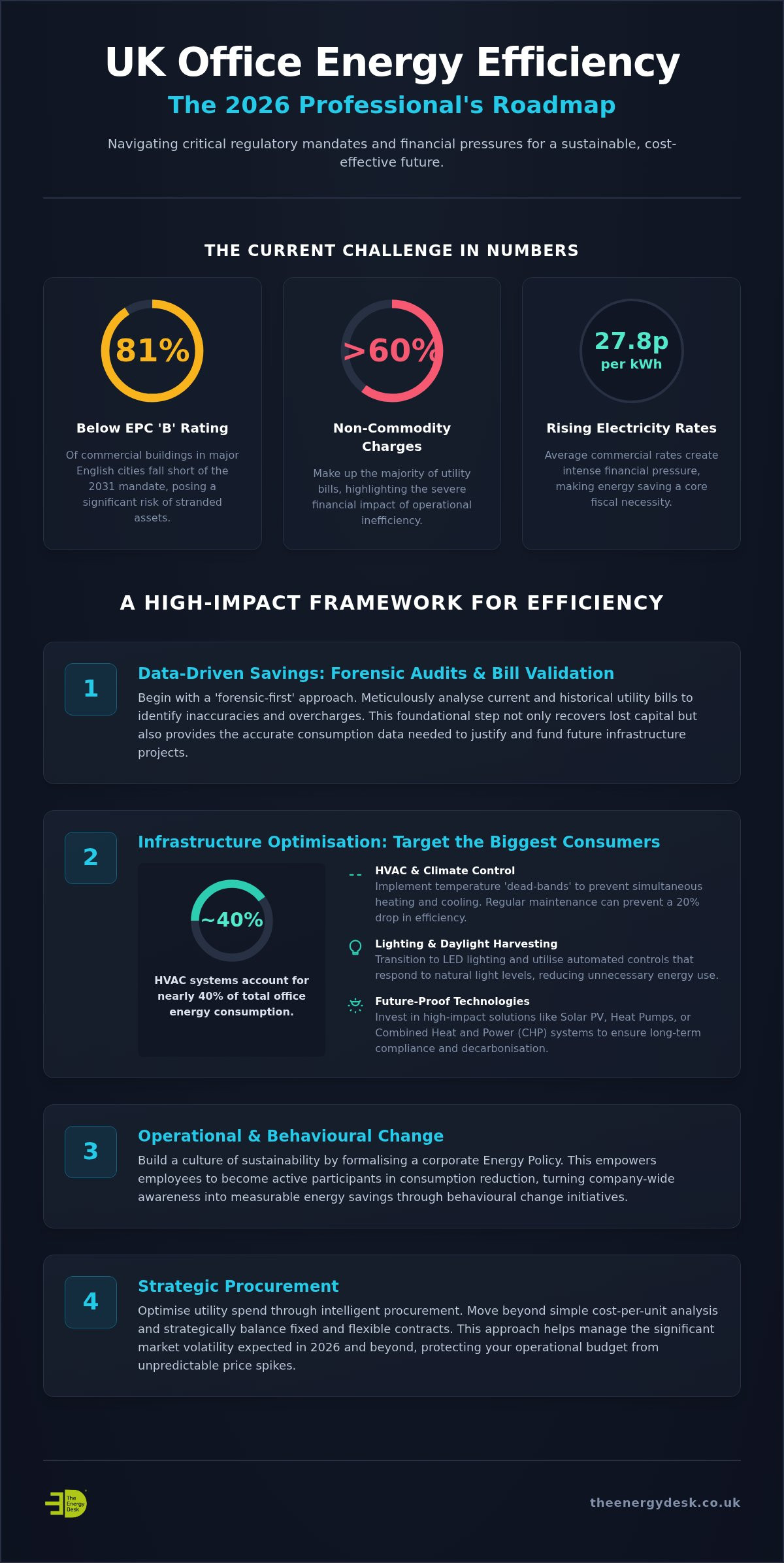
Did you know that 81% of commercial buildings in major English cities currently hold an EPC rating below ‘B’, despite the 2031 mandate for larger properties? With average commercial electricity rates reaching up to 27.8p per kWh and non-commodity charges now making up over 60% of your bill, the financial pressure on UK facilities managers has never been more intense. You likely recognise the strain of unpredictable price volatility and the looming 2030 net-zero targets, especially when invisible waste in your HVAC and lighting systems quietly erodes your margins. Finding effective energy saving tips for office buildings UK is no longer just a sustainability goal; it’s a core operational necessity for fiscal stability.
This guide provides a professional-grade framework to identify and eliminate that waste, helping you lower monthly utility bills and improve your building’s EPC rating. We’ve developed a “forensic-first” roadmap that uses data to drive infrastructure decisions rather than guesswork. You’ll learn how to audit your current consumption, validate your billing accuracy, and implement high-impact solutions like Solar PV and CHP systems to future-proof your office for 2026 and beyond.
Key Takeaways
- Identify how evolving 2026 regulatory pressures like ESOS and SECR directly influence your office building’s operational budget and long-term compliance.
- Execute a high-impact infrastructure strategy by applying practical energy saving tips for office buildings UK, focusing on HVAC optimisation and daylight harvesting.
- Utilise forensic bill validation as a foundational tool to uncover historical billing errors and secure capital for future efficiency projects.
- Build a culture of sustainability by formalising an Energy Policy that empowers employees to lead behavioural change initiatives amongst your workforce.
- Optimise your utility spend through strategic procurement, balancing fixed and flexible contracts to manage the energy market volatility expected in 2026.
The 2026 Landscape: Why UK Office Energy Efficiency is Critical
The year 2026 marks a decisive moment for commercial property management across the nation. As businesses reconcile their operational budgets with the UK’s 2030 net-zero trajectory, energy efficiency has transitioned from a sustainability initiative to a core financial strategy. Wholesale gas prices for Winter 2026 delivery are currently approximately 178 pence per therm. For larger organisations, this translates to delivered costs between 7.9 and 8.4 p/kWh. Electricity unit rates remain equally challenging; average fixed rates for small to medium businesses sit between 26.7p and 27.8p per kWh. When you consider that non-commodity charges now constitute over 60% of a typical bill, the financial risk of inefficiency is clear.
Implementing effective energy saving tips for office buildings UK is essential for maintaining asset value in a tightening market. With 81% of commercial buildings in major English cities currently holding an EPC rating below ‘B’, landlords face a significant risk of stranded assets. Properties that fail to improve their energy performance will likely see a decrease in commercial lease attractiveness as tenants prioritise lower operational costs and better environmental credentials. The cost of “doing nothing” has become a measurable liability on the balance sheet.
Navigating UK Energy Regulations in 2026
Compliance is a major driver for infrastructure change this year. Large undertakings must navigate the requirements of ESOS Phase 4 and SECR, which demand granular visibility into carbon footprints. These mandatory audits shouldn’t be viewed merely as a box-ticking exercise; they serve as a springboard for genuine consumption reduction. The current UK energy conservation policies place a heavy emphasis on non-domestic buildings, reflecting the £49.41 per tonne carbon price set for the 2026 scheme year. Strategic office planning must now account for these costs to avoid civil penalties and ensure long-term viability.
The Financial Impact of Modern Energy Management
Modern management shifts energy from an uncontrollable overhead to a managed variable. By 2026, the correlation between energy performance and fiscal health is undeniable. The government’s decision to focus on a 2031 ‘B’ rating for larger properties provides a clear roadmap for investment. High-performing buildings don’t just save money; they command higher rents and attract stable, long-term tenants who are committed to their own carbon reduction goals. This is the pivotal year for transition, as the extension of the Boiler Upgrade Scheme and the zero VAT rate on energy-saving materials provide a finite window for cost-effective upgrades.
Securing a professional energy audit is the logical first step for any organisation looking to stabilise their costs. This process transforms raw data into a clear, actionable roadmap that aligns with both fiscal and environmental objectives. By integrating these energy saving tips for office buildings UK into your long-term maintenance schedule, you can protect your margins against future market volatility and ensure your building remains a premium commercial asset.
A High-Impact Checklist for Office Infrastructure
Optimising infrastructure is the most direct way to reduce operational costs and meet the 2026 efficiency goals discussed earlier. HVAC systems remain the single largest energy consumer in UK offices, often accounting for nearly 40% of total building consumption. To address this, facilities managers should implement temperature ‘dead-bands’. This ensures that heating and cooling systems don’t operate simultaneously, which is a common source of invisible waste. Regular maintenance is equally vital; a poorly maintained system can see efficiency drop by 20% over its lifespan.
Transitioning to heat pumps or exploring CHP system installation for businesses provides a robust path toward decarbonisation. These technologies align with the Future Buildings Standard, which sets the benchmark for the next generation of non-domestic energy performance. Integrating such solutions is one of the most effective energy saving tips for office buildings UK, ensuring your property remains compliant as standards tighten.
HVAC and Climate Control Optimisation
Effective climate control requires a proactive approach to system management. Beyond dead-bands, you should ensure that your Building Management System (BMS) is correctly calibrated to reflect current occupancy patterns. Many offices still operate heating schedules based on pre-2020 attendance, heating empty floors for 12 hours a day. Modernising these controls allows for precision management, where heating and cooling only activate when sensors detect presence. This level of oversight is essential for any building aiming for an EPC rating of ‘B’ or higher by the end of the decade.
Lighting and Small Power Management
Lighting accounts for a significant portion of an office’s electricity use, but modernising this doesn’t stop at LED retrofitting. Zoning office spaces with PIR sensors ensures that lights only activate when a space is occupied. Another high-impact strategy involves ‘Daylight Harvesting’ technology, which uses sensors to adjust artificial light levels based on the amount of natural light entering the building. This reduces artificial light dependency during peak hours and improves the working environment for staff. Eliminating ‘vampire loads’ from peripheral equipment is another priority. You can achieve this by:
- Deploying smart plug strips to automatically cut power to monitors and printers overnight.
- Inspecting building envelope integrity to identify heat loss in older UK office stock.
- Establishing a clear shutdown procedure for non-essential kitchen and breakroom equipment.
If you’re unsure where your building is losing energy, a professional energy audit can provide the clarity needed to prioritise these infrastructure investments.
Data-Driven Savings: Forensic Audits and Bill Validation
Every successful efficiency strategy must begin with a clear understanding of where your money is actually going. Whilst infrastructure upgrades are vital, they often require capital that’s already hidden within your historical utility spend. This is why commercial utility bill validation is the primary step in our professional framework. By forensically examining past invoices, you can identify historical overcharges and recover capital to fund future energy-saving projects. It’s common for businesses to overlook these errors, assuming that automated billing is always accurate.
Taking control of your data also requires a review of your MOP contracts. Without a reliable Meter Operator, your half-hourly data may be incomplete or inaccurate, making it impossible to spot consumption anomalies. These anomalies often signal equipment failure or out-of-hours waste that would otherwise remain invisible. In the 2026 market, where non-commodity charges are high, even a small discrepancy in recorded peak demand can lead to significant financial penalties.
Forensic Auditing: Finding the Invisible Waste
Forensic audits reveal more than just simple arithmetic errors. They uncover complex billing inaccuracies, such as incorrect standing charges, VAT miscalculations, and Climate Change Levy (CCL) discrepancies. We’ve seen UK businesses recover thousands of pounds through this process, providing the necessary ROI justification for the hardware upgrades mentioned in previous sections. It’s a risk-free method to ensure your 2026 budget isn’t being drained by administrative oversight. Using this data allows you to move energy from an uncontrollable overhead to a managed variable with predictable outcomes.
Real-Time Monitoring and IoT Integration
For large multi-tenanted office buildings, sub-metering is no longer optional. It allows facility managers to allocate costs accurately and identify specific floors or departments that are exceeding their energy targets. Integrating IoT sensors further refines this by matching energy use with actual occupancy levels in real-time. Instead of relying on monthly averages, you gain the ability to turn raw data into actionable insights. This granular level of oversight is one of the most effective energy saving tips for office buildings UK, as it allows for immediate intervention when consumption spikes unexpectedly. When your data is visible, waste becomes impossible to ignore.
By establishing this data foundation, you ensure that every subsequent investment is based on fact rather than estimation. This methodical approach is what separates a standard maintenance routine from a strategic energy management programme.
Operational and Behavioural Change Strategies
Technical infrastructure and forensic data audits, as discussed in previous sections, provide the necessary framework for efficiency. However, the human element remains a critical variable in any building’s performance. Hardware solutions only reach their full potential when the individuals using the space are aligned with organisational goals. Establishing a formal “Energy Policy” ensures that sustainability is woven into your business objectives rather than treated as an afterthought. For 2026, these policies must include realistic, time-bound reduction targets that reflect your building’s specific consumption profile. Integrating practical energy saving tips for office buildings UK into daily operations transforms abstract corporate goals into manageable tasks for every department.
Policy-Led Energy Reduction
Clarity is the enemy of waste. Standardising office temperatures to UK health and safety guidelines (typically between 19°C and 21°C for sedentary office work) prevents “thermostat wars” and reduces unnecessary HVAC load. Implementing strict “Switch-Off” policies for weekends and bank holidays ensures that your building doesn’t consume power whilst empty. This policy should extend to procurement. Every new piece of office equipment, from monitors to kitchen appliances, must meet defined efficiency standards. This prevents the gradual accumulation of inefficient assets that can quietly erode your savings over time.
Engaging the Modern Workforce
The “Green Team” model empowers employees to take ownership of efficiency within their own zones. By appointing energy champions from different departments, you foster a culture of accountability that hardware alone cannot achieve. Communicating the “Why” is essential; linking energy saving to corporate values helps staff understand their personal contribution to the UK’s net-zero targets. Transparency acts as a powerful motivator. Using digital signage to display real-time energy performance allows staff to see the immediate impact of their collective behaviour. Gamification, such as department-level efficiency competitions, turns consumption reduction into a collaborative effort rather than a top-down mandate. Training is the final component. Staff must understand the correct use of climate control and smart tech to avoid overriding automated systems. Providing clear energy saving tips for office buildings UK through regular internal workshops ensures that your workforce remains your greatest efficiency asset.
To begin building a culture of efficiency, contact our team for a comprehensive energy audit to identify the behavioural shifts that will yield the highest returns for your organisation.
Strategic Procurement: The Final Piece of the Efficiency Puzzle
Reducing consumption through infrastructure and behavioural changes is a critical pillar of efficiency. However, the price you pay for the remaining units determines the ultimate success of your fiscal strategy. In the volatile 2026 market, saving energy is only half the battle. Professional business electricity procurement ensures that your reduced usage translates into the lowest possible operational cost. Without a strategic approach to contract management, the savings achieved through technical upgrades can be quickly offset by poorly timed renewals or unfavourable tariff structures.
Protecting your margins requires a proactive stance against out of contract energy rates, which can reach as high as 40.0p per kWh in the current climate. This is nearly 50% higher than average fixed rates. For larger office portfolios, flexible energy contracts often provide a better risk-management tool than standard fixed-rate tariffs. They allow you to purchase energy in tranches, taking advantage of market dips rather than being locked into a single price point during a peak. This level of financial oversight is one of the most sophisticated energy saving tips for office buildings UK, as it addresses the unit cost alongside the consumption volume.
Mastering Energy Procurement
Navigating the complexities of the 2026 utility market requires specialised knowledge. Engaging energy procurement consultants allows you to benchmark your current spend against the wider market and time your entries for 2027 and beyond. It’s essential to understand that your bill consists of more than just the wholesale unit rate. With non-commodity charges now exceeding 60% of total electricity costs, procurement strategies must account for network and policy charges. Strategic timing and forensic contract analysis ensure you aren’t paying for capacity or services your building doesn’t actually require.
Future-Proofing with Onsite Generation
Investing in commercial renewable energy provides the most stable long-term protection against market volatility. The business case for Solar PV on UK office rooftops is stronger in 2026 than ever before, aided by the zero VAT rate on qualifying energy-saving installations. For larger sites with high heat and power demands, Combined Heat and Power (CHP) systems offer a highly efficient alternative to traditional grid reliance. Onsite generation doesn’t just lower your carbon footprint; it significantly reduces your exposure to rising transmission and distribution costs. By generating power at the point of use, you insulate your organisation from the grid investment costs that are currently driving up non-commodity charges across the nation.
Combining these procurement strategies with the infrastructure upgrades discussed in earlier sections creates a comprehensive shield for your operational budget. This dual approach ensures your office building remains both environmentally sustainable and commercially competitive in an increasingly demanding landscape.
Future-Proofing Your Office Energy Strategy
Securing your organisation’s financial stability in 2026 requires a shift from reactive maintenance to strategic energy management. By combining forensic bill validation with targeted infrastructure upgrades and employee engagement, you can transform energy from an uncontrollable overhead into a managed variable. We’ve explored how identifying invisible waste through data and optimising HVAC systems provides the foundation for long-term savings. However, these energy saving tips for office buildings UK are most effective when supported by a robust procurement strategy that protects your margins against market volatility.
The Energy Desk has provided expert energy consultancy for over 20 years, helping businesses navigate complex utility markets with independent procurement from over 20 UK suppliers. We specialise in forensic bill validation and recovery, ensuring you only pay for the energy you actually use. To begin your journey toward a more efficient and compliant workspace, Request a Free Energy Audit and Forensic Bill Review from The Energy Desk today. Taking these proactive steps now ensures your building remains a premium, high-performing asset throughout the 2030 net-zero transition.
Frequently Asked Questions
What is the quickest way to reduce energy consumption in a UK office?
The quickest way to reduce consumption involves implementing low-cost behavioural changes and optimising existing Building Management System settings. Adjusting temperature dead-bands to prevent simultaneous heating and cooling provides immediate results without capital expenditure. You should also ensure that lighting and non-essential equipment are fully powered down outside of core operating hours. These simple energy saving tips for office buildings UK can significantly lower baseline consumption before you consider larger infrastructure investments.
How much can a UK office building save through energy efficiency?
Savings vary based on the building’s age and current efficiency, but most UK offices can reduce their energy spend by 10% to 30% through a combination of technical and operational improvements. For a larger building, this equates to thousands of pounds in annual operational budget recovery. By integrating forensic bill validation with infrastructure upgrades like LED lighting or Solar PV, you protect your margins against the high non-commodity charges that currently drive up electricity costs.
Is an energy audit mandatory for my UK business in 2026?
Energy audits are mandatory for large UK organisations that meet the criteria for the Energy Savings Opportunity Scheme (ESOS). If your business employs 250 or more people or has an annual turnover exceeding £44 million, you must comply with ESOS Phase 4 requirements in 2026. Even for smaller businesses where audits aren’t legally required, a professional review is a vital strategic tool for identifying invisible waste and justifying the ROI of efficiency projects.
What is the difference between an energy broker and an energy consultant?
An energy broker primarily focuses on facilitating supply contracts between your business and utility providers to secure competitive unit rates. In contrast, an energy consultant like The Energy Desk provides a broader suite of management services, including forensic bill validation, consumption audits, and infrastructure project management. Consultants act as strategic partners who help you reduce total consumption volume, whereas brokers typically focus on the price per unit of energy purchased.
How does forensic bill validation help with energy saving?
Forensic bill validation identifies historical inaccuracies in your utility invoices, such as standing charge errors or VAT miscalculations. Whilst it doesn’t directly reduce physical consumption, it recovers capital that was previously lost to billing errors. You can then reinvest these recovered funds into high-impact energy saving tips for office buildings UK, such as upgrading HVAC controls or installing onsite generation, effectively making your efficiency journey self-funding through administrative oversight.
Can I install solar panels on a leased office building in the UK?
You can install solar panels on a leased property, but it requires formal consent from the landlord and often involves a Power Purchase Agreement. These agreements allow tenants to benefit from lower energy rates whilst the landlord improves the building’s EPC rating and asset value. In 2026, the business case is strengthened by the zero VAT rate on qualifying installations, making it an attractive proposition for both parties to discuss during lease negotiations.
What are the best HVAC settings for energy efficiency in a British office?
The most efficient HVAC settings align with UK health and safety guidelines, typically maintaining temperatures between 19°C and 21°C. You should implement a dead-band of at least 4°C to ensure the system doesn’t cycle between heating and cooling unnecessarily. Setting your Building Management System to reflect actual 2026 occupancy patterns, rather than outdated pre-2020 schedules, ensures you aren’t heating empty spaces during early mornings or late evenings when staff attendance is low.
How do I avoid out-of-contract rates when my current energy deal ends?
Avoiding out-of-contract rates requires a proactive procurement strategy that begins at least six to twelve months before your current deal expires. These rates can be up to 50% higher than fixed tariffs, posing a significant risk to your operational budget. By working with a consultant to monitor market fluctuations, you can time your renewal to lock in favourable rates for 2027 or explore flexible contracts that allow you to purchase energy in tranches.