
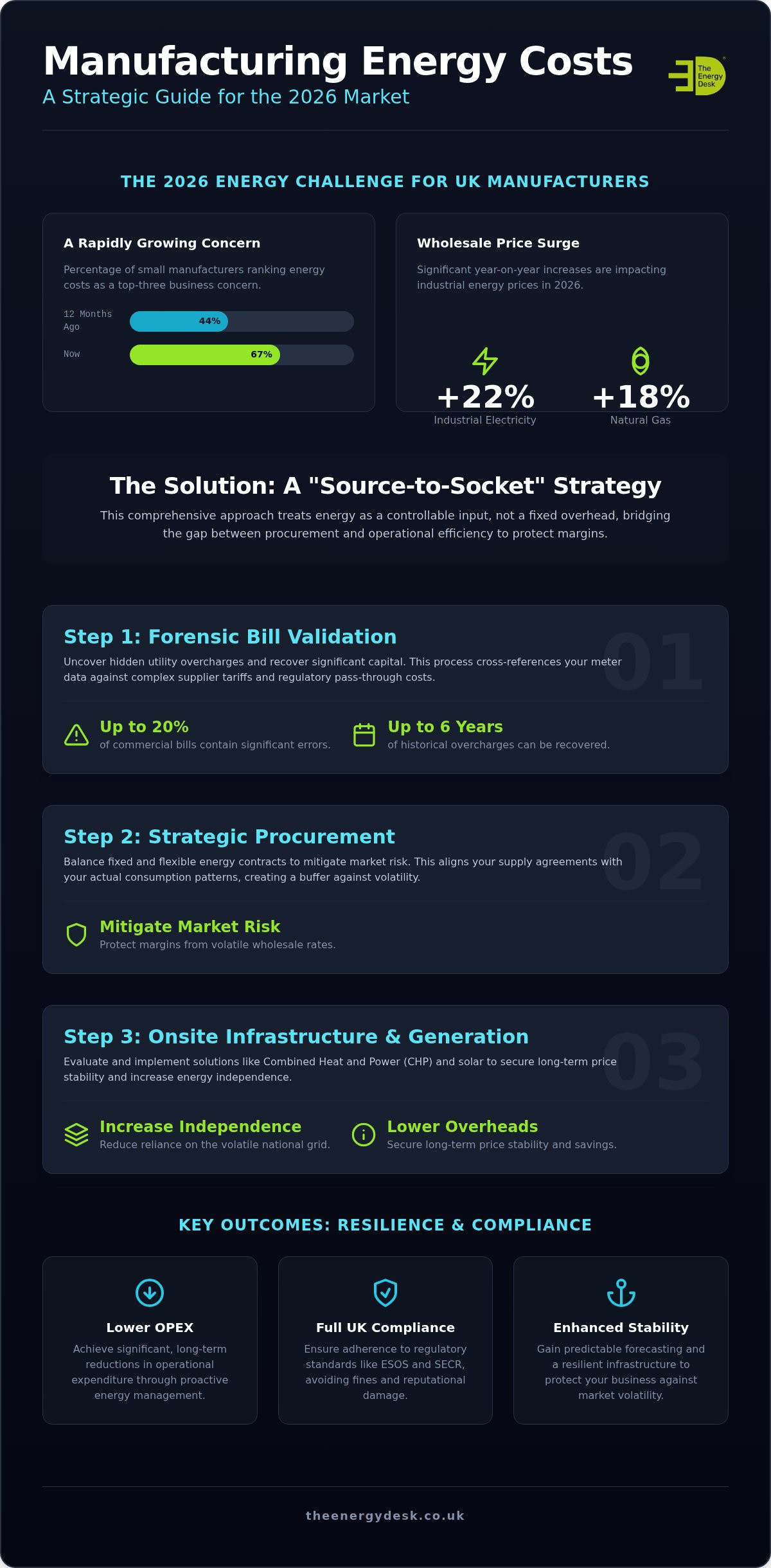
Did you know that 67% of small manufacturers now rank energy costs as a top-three concern, a sharp increase from 44% only twelve months ago? With industrial electricity prices surging by 22% in 2026, learning how to reduce manufacturing energy costs has become a critical priority for protecting your margins whilst meeting strict Net Zero targets. You likely find that volatile wholesale markets and complex, opaque utility bills make it difficult to maintain a predictable bottom line. We recognise that for many UK facilities, energy now accounts for up to 15% of total operational expenditure, leaving very little room for error.
This strategic guide provides a comprehensive framework to transform your utility management through a disciplined, source-to-socket approach. You’ll discover how to identify hidden overcharges in your billing, optimise your procurement strategy for the 2026 market, and implement onsite generation to secure long-term price stability. By moving from reactive payment to proactive management, you can achieve lower OPEX and ensure full compliance with UK energy reporting regulations. We’ll outline the exact steps to audit your current consumption and transition toward a more resilient, cost-efficient infrastructure.
Key Takeaways
- Understand why the “Source-to-Socket” strategy is essential for navigating 2026 wholesale volatility whilst maintaining competitive industrial margins.
- Learn how forensic bill validation can uncover hidden utility overcharges and recover significant capital for your business.
- Discover how to reduce manufacturing energy costs by balancing fixed and flexible procurement strategies to mitigate market risk.
- Evaluate the strategic benefits of onsite generation, including CHP and solar solutions, to increase energy independence and lower overheads.
- Establish a continuous management framework to ensure long-term efficiency, predictable forecasting, and compliance with UK reporting standards.
The Manufacturing Energy Landscape: Why Efficiency is Essential in 2026
The 2026 energy market presents a formidable challenge for UK industry. Wholesale electricity prices have risen to an average of $0.142/kWh, representing a 22% increase from the previous year. Natural gas has followed a similar trajectory, climbing 18% to $4.95/MMBtu. These shifts aren’t just temporary spikes. They reflect a structural transition toward higher demand driven by data centres and industrial electrification. For those seeking how to reduce manufacturing energy costs, the standard approach of annual switching is no longer sufficient to protect the bottom line.
We advocate for a “Source-to-Socket” management philosophy. This approach treats energy as a strategic input rather than a fixed overhead. It bridges the gap between procurement strategy and operational efficiency. By aligning your supply contracts with your actual consumption patterns, you create a buffer against the 14% rise in Brent crude oil prices seen in 2026. This strategy also supports decarbonisation goals. Reducing waste directly lowers your carbon footprint whilst ensuring you remain competitive in a high-cost environment.
The Real Cost of Inefficiency on Industrial Margins
Energy expenditure typically accounts for between 8% and 15% of total operating expenses in the manufacturing sector. However, the true impact is often obscured by hidden inefficiencies. Poorly maintained machinery and unoptimised production schedules lead to significant waste. Demand charges alone can represent up to 50% of a facility’s total utility bill. Applying fundamental energy efficiency principles allows firms to view energy as a controllable variable. Small adjustments to peak-time usage or equipment calibration can protect margins that are otherwise eroded by volatile wholesale rates.
Regulatory Compliance: ESOS and SECR in 2026
UK manufacturers face rigorous reporting requirements through the Energy Savings Opportunity Scheme (ESOS) and Streamlined Energy and Carbon Reporting (SECR). In the 2026 regulatory cycle, compliance isn’t merely a box-ticking exercise. It’s a financial necessity. The data gathered for these reports provides a clear roadmap for identifying where capital is being lost through heat leaks or inefficient processes. Failing to meet these standards risks heavy fines and reputational damage. Conversely, using these audits to inform how to reduce manufacturing energy costs ensures that your efficiency investments are data-driven and targeted for maximum ROI.
Step 1: Forensic Bill Validation – Identifying Hidden Overcharges
Identifying billing errors is a primary step in understanding how to reduce manufacturing energy costs. Industry estimates suggest that up to 20% of commercial energy bills contain significant errors, particularly for high-volume users with complex supply agreements. These discrepancies often involve intricate non-commodity charges such as Distribution Use of System (DUoS) and Transmission Network Use of System (TNUoS). A forensic commercial utility bill validation goes beyond basic arithmetic. It cross-references your actual half-hourly meter data against specific supplier tariffs and regulatory pass-through costs. This methodical approach uncovers overcharges that standard automated software often misses.
Historical overcharges can typically be recovered for up to six years, providing a retroactive correction that returns capital to your business. This process provides an immediate financial injection that can fund other practical energy-saving tips, such as equipment upgrades or process optimisations. By auditing past invoices, you ensure that your future budget isn’t built on a foundation of inaccurate data.
Analysing Standing Charges and KVA Capacity
Available Capacity (KVA) represents the maximum amount of power your site is authorised to draw from the grid at any given time. Many manufacturers find they’re paying for significantly more capacity than they ever actually use. You can reduce business energy standing charges by aligning your KVA limit with your actual peak demand requirements. KVA is the measure of “apparent power” that represents the total demand you place on the grid, and maintaining an excessive allowance directly inflates standing charges without benefiting your operational output. We recommend a detailed demand analysis to ensure you aren’t paying a “reservation fee” for power that your machinery never draws.
The Role of Data Collection and DC/DA Services
Precise billing relies on robust data integrity. Half-hourly data collection ensures that your invoices reflect actual usage patterns rather than supplier estimates, which are notoriously prone to over-calculation. This requires professional Data Collection and Data Aggregation (DC/DA) services, often managed through specific MOP contracts that ensure your metering equipment is compliant and communicative. Granular data allows you to identify energy leaks during non-production hours. You might discover that lighting or compressed air systems are left running whilst the factory is idle, contributing to the 25% energy waste typically found in commercial facilities. If you suspect your current billing is inaccurate, a free energy audit can provide the technical clarity needed to begin the recovery process.
Step 2: Strategic Procurement – Fixed vs Flexible Energy Contracts
Whilst forensic auditing recovers past losses, strategic procurement secures your future financial health. Navigating the 2026 energy market requires more than just accepting the first renewal quote. For high-volume industrial users, the choice between fixed and flexible contracts is a cornerstone of how to reduce manufacturing energy costs. Fixed-price contracts provide absolute budget certainty, protecting your facility against sudden price spikes; however, they often include a risk premium from the supplier. Flexible procurement allows you to purchase energy in tranches throughout the contract period. This strategy is central to effective commercial energy risk management, as it enables your business to hedge against volatility whilst capitalising on downward market movements.
Timing the market is essential for successful procurement. With European gas storage levels currently at 68%, which is below the five-year average, the risk of winter price surges remains high. Manufacturers can also explore group procurement or “basket” buying. By combining your energy load with other businesses, you can access the lower unit rates typically reserved for major industrial players. This collective approach increases your bargaining power and provides access to more favourable contract terms that are otherwise unavailable to individual mid-sized facilities.
When to Choose Flexible Procurement
Flexible contracts are generally suited to facilities with a high annual spend or those with a sophisticated understanding of their load profile. Engaging energy procurement consultants provides the technical oversight needed to monitor market triggers and execute trades at the optimal moment. This proactive approach ensures you aren’t locked into high rates when wholesale prices soften. It allows your business to remain agile, adjusting your buying strategy as market conditions evolve throughout 2026.
Avoiding the “Out-of-Contract” Rate Trap
Falling onto deemed or out-of-contract rates is one of the most expensive mistakes a manufacturer can make. These rates are significantly higher than negotiated tariffs and can immediately erode your operational margins. It’s vital to identify and exit out of contract rates as soon as they occur. Setting up proactive renewal alerts at least six months before your current agreement expires is a simple yet effective way to protect your future expenditure. This lead time allows for a thorough market analysis and ensures you never pay a premium for lack of preparation. This discipline is a fundamental part of how to reduce manufacturing energy costs over the long term.
Step 3: Onsite Infrastructure and Generation (CHP & Solar)
Optimising how you buy energy is only half the battle. To achieve a structural shift in your overheads, you must address how your facility consumes and generates power physically. Implementing “behind the meter” generation allows you to bypass significant portions of the grid’s non-commodity charges, which continue to rise as the UK’s infrastructure undergoes electrification. By generating power at the point of use, you reduce your reliance on a volatile wholesale market and insulate your production lines from potential grid instability. This transition is a fundamental pillar of how to reduce manufacturing energy costs whilst simultaneously future-proofing your operations against further price hikes.
The ROI of onsite generation has never been more compelling. With industrial electricity prices reaching historic highs in 2026, the payback period for capital-intensive projects has shortened significantly. When you compare the levelised cost of onsite energy against traditional grid supply, the long-term savings often justify the initial expenditure within a few years. This shift transforms energy from a volatile monthly expense into a predictable, managed asset.
The Power of Combined Heat and Power (CHP)
For heat-intensive industries such as food processing, chemical manufacturing, and plastics, Combined Heat and Power (CHP) remains the gold standard for efficiency. These systems generate electricity onsite whilst capturing the byproduct heat that traditional power stations simply vent into the atmosphere. This “waste” heat provides a source of free thermal energy for steam, hot water, or space heating. A modern CHP unit can achieve total fuel efficiencies exceeding 80%, which is a vast improvement over the 30-40% efficiency typical of grid-supplied power. This dual-utility output ensures that every unit of fuel you purchase works twice as hard for your business.
Solar PV and Battery Storage for Peak Shaving
Large-scale manufacturing facilities often possess expansive roof spaces that are ideal for commercial solar PV arrays. These systems are particularly effective at reducing daytime grid demand, which often coincides with the most expensive peak-rate periods. However, solar generation is naturally intermittent. To maximise the business case for renewable energy in 2026, we recommend pairing solar arrays with battery storage solutions. This combination allows you to “shave” your peak demand by storing excess solar energy generated during the day and deploying it when grid prices are at their highest. If you’re ready to evaluate the feasibility of these technologies for your site, contact our infrastructure team for a technical site assessment.
Implementing a Continuous Energy Management Framework
Transitioning from isolated energy-saving projects to a structured business energy portfolio management approach is the final step in mastering how to reduce manufacturing energy costs. One-off equipment upgrades offer temporary relief, but long-term fiscal responsibility requires a continuous cycle of oversight. By treating energy as a managed portfolio, you can reinvest the capital recovered from historical bill validation into high-yield infrastructure projects like CHP or solar PV. This creates a self-funding loop where immediate OPEX reductions provide the necessary CAPEX for future-proofing your facility against the volatile 2026 market.
Building a robust business case for these investments requires precise, ongoing data. Professional energy audits shouldn’t be viewed as a one-time compliance requirement for SECR or ESOS. Instead, they serve as an essential performance benchmark. Regular site surveys allow you to track the impact of previous interventions and identify new inefficiencies as production volumes shift. It’s about maintaining a disciplined, analytical mindset that ensures your energy strategy evolves alongside your operational needs.
The Value of a Free Energy Audit
A professional audit provides a comprehensive technical overview of your site’s current performance. It covers everything from detailed bill analysis to physical site surveys of process heating and compressed air systems. By categorising potential improvements by their payback periods, you can prioritise actions that offer the fastest ROI. This methodical approach ensures that your resources are directed toward the most impactful measures first. If you’re ready to identify immediate savings and establish a baseline for your facility, you can Request your free energy audit from The Energy Desk to begin your strategic transition.
Establishing an Internal Energy Culture
Technology alone won’t solve inefficiency if the human element is ignored. Establishing an internal energy culture involves training staff to recognise waste, such as equipment left idling between shifts or unnecessary lighting in storage areas. Setting specific KPIs for energy intensity per unit of production makes efficiency a shared operational goal rather than just a finance department concern. Smart sub-metering plays a vital role here, as it provides the granular data needed to hold individual departments accountable for their consumption. This transparency is a powerful tool for anyone looking at how to reduce manufacturing energy costs through behavioural change. It ensures that every level of the organisation is invested in the facility’s long-term cost-efficiency and operational success.
Securing Your Industrial Energy Future in 2026
The 2026 energy landscape demands a transition from passive utility payment to active, strategic management. By integrating forensic auditing with onsite infrastructure such as CHP and solar, you can transform energy from a volatile overhead into a controllable operational variable. This guide has outlined how to reduce manufacturing energy costs through a disciplined “Source-to-Socket” framework that protects your margins whilst ensuring full compliance with UK reporting standards. Recovering historical overcharges and optimising procurement tranches provides the financial foundation for long-term resilience.
With over 20 years of industrial energy expertise, The Energy Desk serves as a methodical partner for businesses navigating these technical complexities. We specialise in forensic bill validation that has recovered millions for our clients, alongside expert project management for complex CHP and solar installations. Taking control of your utility expenditure starts with a clear, data-driven understanding of your current inefficiencies. Book your free, no-obligation energy audit with The Energy Desk today to begin identifying immediate savings. Proactive management is the most reliable path to achieving fiscal stability and a competitive advantage in a high-cost environment.
Frequently Asked Questions
How much can a typical manufacturer save by switching to flexible energy procurement?
Flexible procurement allows businesses to purchase energy in tranches, capitalising on market dips rather than locking in a single rate. Whilst exact savings depend on your consumption profile and market timing, manufacturers often see a reduction of 20% to 35% in total energy costs within the first year of adopting proactive management. This strategy is a primary method for anyone investigating how to reduce manufacturing energy costs, as it avoids the high risk premiums associated with fixed-rate contracts.
What is the average payback period for a CHP system in a UK factory?
The average payback period for a CHP system typically ranges between three and five years; however, this has shortened recently due to the 22% increase in industrial electricity prices seen in 2026. Systems are most efficient in factories with high, consistent thermal demands. By capturing waste heat, these units significantly lower overall primary energy consumption. The exact ROI depends on your facility’s spark spread, which is the difference between the cost of gas and the value of generated electricity.
Are there any UK government grants available for manufacturing energy efficiency in 2026?
UK manufacturers can often access support through the Industrial Energy Transformation Fund (IETF), which is designed to help high-energy industries transition to low-carbon technologies. Various regional decarbonisation grants also exist to support capital expenditure on efficiency measures. These schemes are essential for businesses exploring how to reduce manufacturing energy costs whilst meeting Net Zero targets. We recommend checking the latest government eligibility criteria, as funding rounds and specific requirements are subject to periodic updates and regional availability.
How do I know if my manufacturing business is being overcharged on energy bills?
A high probability of overcharging exists if your bills haven’t undergone forensic validation, as up to 20% of commercial invoices contain errors. You should look for discrepancies in Distribution Use of System (DUoS) charges, incorrect VAT applications, or excessive Available Capacity (KVA) allowances. If your standing charges remain static despite production changes, it is likely you are paying for unused capacity. A professional audit can cross-reference your half-hourly data against your specific contract terms to identify these hidden costs.
What is the difference between an energy broker and an energy procurement consultant?
An energy broker primarily focuses on the transaction of switching suppliers to find a lower rate at a specific point in time. In contrast, an energy procurement consultant acts as a strategic partner, providing ongoing oversight through bill validation, infrastructure projects, and risk management. This consultative approach ensures long-term efficiency rather than a one-off fix. Consultants provide technical expertise in areas like CHP and solar, helping businesses manage their entire utility portfolio as a strategic asset for the business.
Can I install solar panels if my factory is on a leased property?
You can install solar panels on a leased property, though it usually requires formal consent from the landlord and a review of your lease agreement. Many manufacturers opt for a Power Purchase Agreement (PPA), where a third party installs the panels and sells the electricity to the tenant at a reduced rate. This allows you to benefit from onsite generation without a significant capital outlay. Such arrangements often increase the property’s value, making them an attractive proposition for forward-thinking landlords.
What are the most common energy-wasting processes in heavy manufacturing?
Compressed air systems are frequently the largest source of waste; leaks and poor maintenance often account for 30% of their energy consumption. Process heating and cooling systems also contribute significantly through poor insulation and unoptimised thermal cycles. Additionally, machinery left idling during non-production hours or between shifts represents a major energy leak. Addressing these areas through smart monitoring and sub-metering is a proven way to achieve immediate reductions in your operational expenditure and overall carbon footprint.
How does half-hourly metering help reduce manufacturing energy costs?
Half-hourly metering provides the granular data needed to move away from supplier estimates, which are often inflated. This precision allows you to identify peak demand periods where you might be incurring heavy red-zone DUoS charges. By understanding exactly when your facility uses the most power, you can shift non-essential processes to cheaper time periods. This transparency is a critical tool for anyone seeking how to reduce manufacturing energy costs, as it provides the evidence needed for targeted efficiency investments.