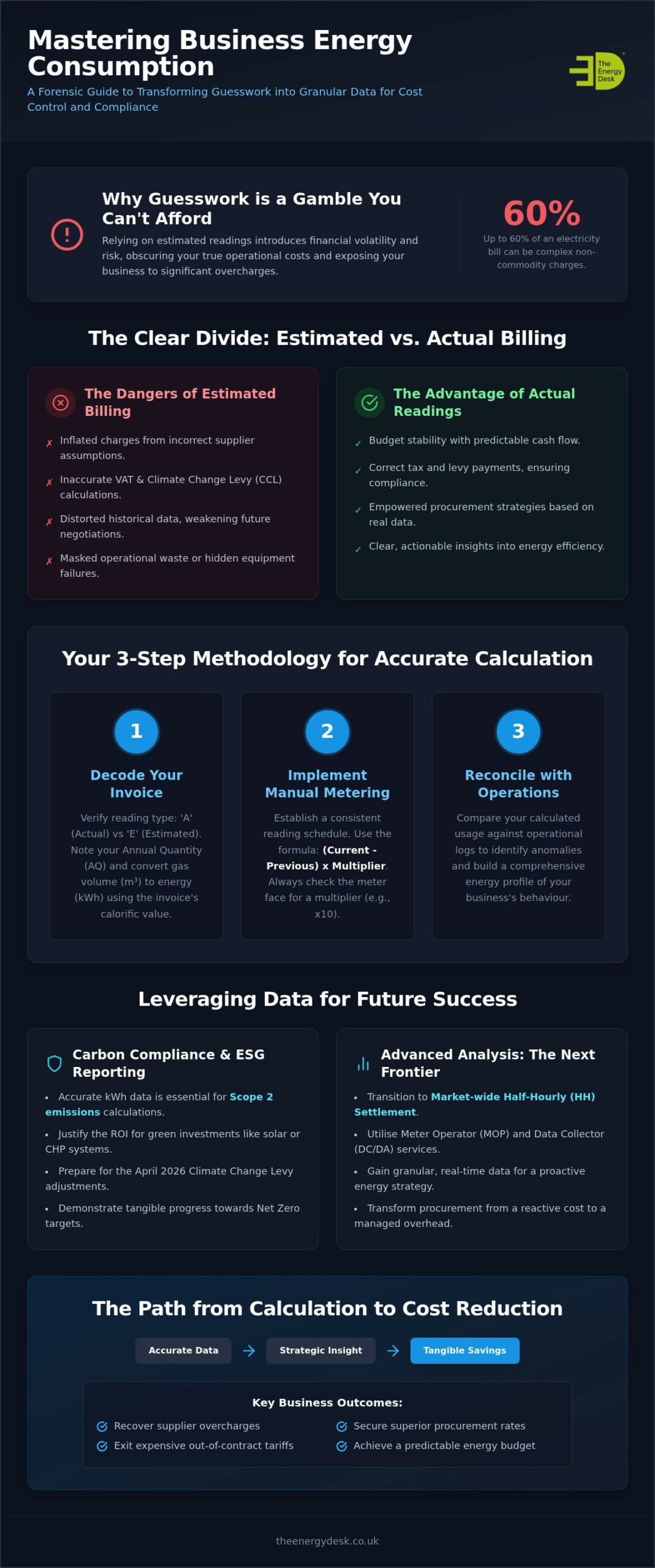
What if your most significant overhead is being managed using guesswork instead of granular data? Many organisations face unpredictable energy bills and a lingering suspicion of being overcharged, yet they lack the technical framework to verify their costs. Understanding how to calculate business energy consumption is no longer just a task for the accounts department; it’s a strategic necessity for fiscal responsibility in an increasingly volatile market. With non-commodity charges now accounting for up to 60% of electricity costs for some businesses, relying on estimated readings is a risk you simply can’t afford to take.
We recognise that technical terms like kVA and kWh often create unnecessary confusion when you’re trying to stabilise your budget. This forensic guide promises to demystify these metrics and provide a repeatable methodology for mastering your commercial utility usage. You’ll learn how to identify supplier errors, prepare for the April 2026 Climate Change Levy adjustments, and establish a robust foundation for future energy efficiency audits. We will explore the shift towards Market-wide Half-Hourly Settlement and explain how precise data collection through MOP and DC/DA services can transform your procurement strategy from reactive to proactive.
Key Takeaways
- Understand why accurate kilowatt-hour (kWh) measurement is the essential first step in forensic bill validation and recovering supplier overcharges.
- Learn the precise steps for how to calculate business energy consumption using a combination of VAT invoice data and regular manual meter readings.
- Compare your operational profile against 2026 benchmarks for SMEs and specific sectors to identify hidden inefficiencies.
- Discover how Half-Hourly metering and specialised DC/DA services provide the granular data flow required for strategic energy oversight.
- Transition from raw data to cost savings by using your consumption profile to secure better procurement rates and exit expensive out-of-contract tariffs.
The Strategic Importance of Calculating Business Energy Consumption
Energy consumption is defined as the total amount of kilowatt-hours (kWh) your business utilises over a specific period. This figure is the bedrock of any professional energy accounting system, providing the empirical evidence needed to manage overheads effectively. Without this data, you’re essentially operating in the dark. Learning how to calculate business energy consumption allows you to transition from passive bill payment to active cost management. It’s the essential first step in commercial utility bill validation. By reconciling your actual usage against supplier invoices, you can identify discrepancies that frequently result in significant overcharges.
Why ‘Estimated’ is the Enemy of Profit
Suppliers often rely on historical data or regional averages to generate invoices when actual meter readings are unavailable. Estimated billing is a temporary placeholder that often leads to significant financial reconciliation issues. These estimates frequently skew higher during peak periods, causing immediate and unnecessary cash flow strain. Even worse, under-estimation leads to “catch-up” bills. These sudden, large demands for payment can cripple a quarterly budget and disrupt planned capital expenditure. Precise calculation removes this volatility. It ensures your accounts reflect reality rather than a supplier’s best guess. Key risks of relying on estimates include:
- Inflated standing charges based on incorrect capacity assumptions.
- Inaccurate VAT and Climate Change Levy (CCL) applications.
- Loss of historical data accuracy for future procurement negotiations.
- Difficulty in identifying internal operational waste or equipment failure.
Calculating for Carbon Compliance
As we move through 2026, the regulatory pressure for ESG transparency has intensified. Accurate energy data is now mandatory for carbon footprint reporting across many UK sectors. Knowing your exact kWh usage is the only way to perform accurate Scope 2 emissions calculations, which cover indirect emissions from purchased electricity. This data does more than satisfy regulators; it provides the business case for infrastructure upgrades. When you understand your consumption patterns, you can accurately forecast the return on investment for renewable solutions like solar arrays or CHP systems. Accurate measurement turns sustainability from a vague goal into a quantifiable financial strategy. It allows your organisation to demonstrate genuine progress towards Net Zero targets rather than relying on broad approximations.
Primary Methods for Calculating Commercial Energy Usage
To master how to calculate business energy consumption, you must adopt a methodical approach that goes beyond simply checking the final figure on a bill. Relying solely on supplier data often leaves businesses vulnerable to systemic errors. A forensic approach involves reconciling three distinct data sources: your historical invoices, manual meter readings, and your internal operational log. Understanding how energy is used across different commercial sectors provides a useful benchmark for your own efficiency targets, but your internal data remains the ultimate source of truth.
Decoding Your Energy Invoice
Your journey starts with the ‘Tariff Details’ section of a recent VAT invoice. Here, you’ll find your Annual Quantity (AQ) or Estimated Annual Consumption (EAC). It’s vital to check whether the reading type is marked as ‘A’ for Actual or ‘E’ for Estimated. If your bill is consistently based on estimates, your calculated consumption will be inaccurate. Differentiating between gas units (m3) and billing units (kWh) is another common stumbling block. Gas meters measure volume, which must be converted using the calorific value and a correction factor found on your invoice to reach the billed energy figure.
Manual Metering Best Practices
Perform manual meter readings at consistent intervals, such as 09:00 every Monday. This creates a standardised log that accounts for your weekly operational cycle. The formula for calculation is straightforward: (Current Reading – Previous Reading) x Meter Multiplier. Some commercial meters have a multiplier (e.g., x10 or x100) clearly marked on the face; failing to account for this will result in a massive under-calculation. For businesses with multi-rate meters, you must record Day, Night, and Evening rates separately to understand how your load profile affects your total costs.
Account for seasonal variations by using a 12-month rolling average. This prevents a cold winter or a particularly hot summer from skewing your long-term procurement strategy. You must also factor in non-commodity charges that scale with consumption volume. From 1 April 2026, the main rate for the Climate Change Levy (CCL) is £0.00801/kWh for both electricity and gas. These levies, combined with transmission and distribution costs, mean that every kWh saved has a compounded financial benefit.
Validate supplier data against your own internal records to spot discrepancies early. If your manual logs show a consistently lower usage than your invoices, you may be a victim of meter serial number errors or incorrect industry data. If you find discrepancies during this process, The Energy Desk can provide a forensic analysis to ensure your billing is accurate and recover any historic overcharges.
Benchmarking Your Business: What is ‘Normal’ Consumption in 2026?
Once you understand how to calculate business energy consumption, the next logical step is to contextualise those figures. Benchmarking allows you to compare your performance against industry standards to determine if your utility spend is proportionate to your output. This process is the primary way to identify “energy leaks” where usage exceeds the expected profile for your building type or operational hours. In a market defined by 2026 efficiency standards, being “average” is often no longer sufficient for long-term fiscal stability.
Consumption by Business Scale
Energy requirements scale dramatically with the size of your organisation. Micro-businesses typically consume under 15,000 kWh of electricity and approximately 5,000 kWh of gas annually. Small businesses generally fall within the 15,000 to 30,000 kWh bracket, whilst medium-sized enterprises (SMEs) often range from 30,000 to over 65,000 kWh. For medium-sized industrial sites, usage frequently enters the millions of kWh due to heavy machinery and continuous shift patterns. Large-scale procurement for multi-site portfolios requires a sophisticated approach to ensure every location remains within its efficient benchmark, as even a minor percentage deviation across fifty sites can result in six-figure losses.
Sector-Specific Usage Patterns
Sector-specific profiles vary significantly; a data centre or cold storage facility will naturally have a vastly different footprint compared to a professional services firm. High-intensity users face the greatest financial risk from operational inefficiencies. Adopting the ENERGY STAR framework for commercial buildings provides a rigorous method for assessing whether your premises are performing at peak efficiency relative to their specific use case. For organisations operating across multiple sectors or locations, professional business energy portfolio management is essential to balance diverse site needs and consolidate data for board-level reporting.
In 2026, national benchmarks have tightened due to the Second Progress Update for ESOS Phase 3 and the impending Phase 4 requirements. If your calculated consumption is 15% higher than the average for your sector, it often indicates faulty equipment, poor insulation, or “phantom loads” from systems left running outside of core hours. Identifying these leaks through benchmarking doesn’t just lower your immediate overheads; it provides the evidence needed to justify capital investment in more efficient infrastructure. By aligning your actual usage with these modern standards, you create a robust baseline for future energy audits and more competitive procurement strategies.
Forensic Data Analysis: Leveraging Half-Hourly Metering and DC/DA
Manual readings are a solid start, but for complex operations, they lack the granularity needed for strategic optimisation. Forensic data analysis relies on Half-Hourly (HH) metering, which records usage every thirty minutes. This high-frequency data is the only way to truly master how to calculate business energy consumption for large-scale or high-intensity sites. It provides a heat map of your operational efficiency, revealing exactly when and where your money is being spent. Without this level of detail, you cannot identify the specific behaviours that drive up your utility costs.
To access this data effectively, your infrastructure must be supported by the correct commercial agreements. MOP contracts for UK businesses are essential because they cover the installation and maintenance of the meter itself, ensuring the hardware is capable of transmitting data accurately. Without an independent MOP agreement, you’re often left with default supplier arrangements that may not prioritise data transparency or provide the access you need for forensic auditing.
The Power of Granular Data
Granular data allows you to visualise consumption peaks and shift heavy operations away from “red zone” periods, typically between 16:00 and 19:00, when distribution charges are at their highest. It also exposes baseload waste, which is the energy consumed whilst your business is technically closed. If your 3:00 am usage is unexpectedly high, it usually points to equipment left on standby or faulty climate control systems. For organisations in the hospitality sector, this often highlights the need for more efficient appliances; you can learn more about Island Catering Equipment Co. to find professional equipment designed for lower energy consumption. DC/DA services act as the bridge between your physical meter and the supplier’s billing system. Data Collection (DC) ensures the raw readings are retrieved, whilst Data Aggregation (DA) formats that data for the supplier to ensure your bill is based on reality rather than a flawed algorithm.
Beyond the unit rate, forensic analysis focuses on your “Available Capacity,” measured in kVA. This is the maximum amount of power the grid reserves for your site. Many businesses pay for a capacity level far higher than their actual peak requirement, leading to inflated standing charges every month. By calculating your peak demand over a 12-month period, you can identify if you’re over-allocated. Forensic auditing identifies capacity over-allocation and enables you to negotiate a reduction, which can result in immediate, recurring savings on your monthly invoices without requiring any change in your daily operations.
Balancing these technical elements requires a specialised skillset that many internal finance teams lack. If you want to move beyond basic estimates and secure a transparent view of your utility spend, contact The Energy Desk for a forensic audit to identify hidden savings in your data and ensure your capacity charges are correctly aligned with your actual needs.
From Calculation to Cost Reduction: Strategic Next Steps
Mastering how to calculate business energy consumption is the prerequisite for forensic cost control, but the data itself is merely a tool for broader strategic action. Once you have a clear understanding of your usage patterns, you can transition from simple budgeting to sophisticated business electricity procurement. This shift allows your organisation to use its load profile as leverage during negotiations, ensuring that the contracts you sign are tailored to your specific operational needs rather than generic industry averages.
One of the most immediate benefits of accurate calculation is the ability to identify out of contract energy rates. Businesses without a formal agreement are often placed on “deemed” rates, which can be two to three times higher than market averages, sometimes exceeding 40p/kWh. By reconciling your meter data against your contract end dates, you can avoid these punitive tariffs and ensure a seamless transition between suppliers. This proactive oversight is a core component of a modern commercial energy risk management strategy, protecting your cash flow from market volatility and administrative oversights.
Procurement Based on Profiles
Your “load profile”—the pattern of how your energy use rises and falls throughout the day—dictates whether you should opt for fixed or flexible pricing. High-intensity users often benefit from flexible contracts that allow for purchasing energy in tranches, whilst smaller sites may prefer the price certainty of a fixed-rate agreement. Accurate volume forecasting is also vital for gas contracts to prevent “take-or-pay” penalties, where you’re charged for energy you committed to buy but didn’t actually use. Many organisations find that collaborating with energy procurement consultants is the most effective way to leverage this data, as specialists can interpret complex consumption trends to secure the most advantageous terms.
The Path to Long-Term Efficiency
Forensic consumption data allows you to set realistic, science-based reduction targets rather than arbitrary goals. If your data shows a high baseload, you might prioritise automated building management systems; if your peak demand is high, you might evaluate the feasibility of onsite generation. Technologies like Solar Solutions or CHP systems can significantly reduce your reliance on the grid, but their financial viability depends entirely on the accuracy of your initial calculations. By using your 2026 consumption profile as a baseline, you can calculate the exact payback period for these infrastructure investments.
Ultimately, the goal of energy calculation is to eliminate waste and reclaim control over your utility spend. If you’re ready to move beyond basic meter readings and uncover the hidden efficiency opportunities within your data, contact The Energy Desk for a free forensic energy audit to validate your consumption and identify immediate savings.
Securing Your Competitive Advantage Through Data
Transitioning from estimated billing to granular, half-hourly data is the only way to ensure fiscal accuracy in the 2026 market. Benchmarking your usage against sector standards identifies operational waste and justifies strategic infrastructure investment. Mastering how to calculate business energy consumption provides the forensic evidence needed to exit punitive rates and negotiate bespoke procurement contracts that reflect your actual load profile. When your data is precise, your budgeting becomes predictable and your overheads remain under control.
The Energy Desk has operated as an independent consultancy since 2003, providing national UK coverage and expert forensic bill validation services for all commercial sectors. Don’t let supplier errors or unmanaged capacity charges erode your profit margins. Request a free, forensic energy audit from The Energy Desk today to validate your data and eliminate hidden billing errors. Accurate data is the foundation of a resilient utility strategy; take the first step toward total transparency now. Your organisation deserves a utility strategy built on precision rather than approximations.
Frequently Asked Questions
How do I find my business energy consumption if I don’t have a bill?
Contact your current supplier to request a Statement of Account or access your online customer portal for historical data. If you’re unsure who your supplier is, check the Meter Point Administration Service (MPAS) for electricity or the Find My Supplier service for gas. You can also view the physical meter to record current readings and compare them over time to establish a baseline for how to calculate business energy consumption manually.
What is the difference between kWh and kVA in business energy calculation?
Kilowatt-hours (kWh) measure the actual energy you consume, whilst kilovolt-amperes (kVA) represent the total power capacity supplied to your site. Think of kWh as the volume of energy used and kVA as the size of the pipe providing it. Businesses often pay for kVA through “Available Capacity” charges. If your kVA limit is set significantly higher than your peak demand, you’re paying for infrastructure capacity that your organisation never actually utilises.
Is a smart meter the same as a half-hourly meter for a business?
No, they serve different functions within the commercial market. A smart meter sends periodic readings to your supplier to ensure billing accuracy. A Half-Hourly (HH) meter is a specific type of commercial meter required for high-demand sites, recording usage every 30 minutes for settlement purposes. HH meters require specialised MOP and DC/DA contracts to manage the granular data flow, providing a far more detailed profile of your operational efficiency.
Can I calculate my energy consumption by looking at individual appliances?
You can estimate the usage of specific equipment by multiplying its power rating in kW by the hours it’s operational. For example, a 2kW heater running for five hours consumes 10kWh. Whilst this helps identify specific “energy leaks” or high-drain machinery, it doesn’t account for complex system losses or shared infrastructure. For businesses requiring deeper technical diagnostics, you can discover Zenith Rental to see the range of advanced power testing equipment used to pinpoint electrical waste. A forensic audit of your main meter remains the only way to accurately determine your total commercial utility spend.
Professional organisations should conduct a forensic energy audit at least once a year or whenever a significant change in operations occurs. Regular reviews ensure that your “Available Capacity” remains aligned with your actual peak demand and that you aren’t being overcharged by suppliers. Frequent auditing also prepares your business for mandatory reporting deadlines, such as those associated with ESOS Phase 3 and Phase 4 regulations scheduled for 2026 and 2027.
What happens if my calculated consumption is much lower than my bill?
This discrepancy usually indicates a billing error, such as an incorrect meter multiplier, a crossed meter, or a supplier over-estimating your usage. You should immediately perform a manual meter reading to verify the data. If the gap persists, it’s essential to initiate a formal bill validation process. Forensic specialists can often recover historic overcharges dating back several years by proving that the supplier’s data doesn’t match your physical consumption records.
Does business size significantly change the calculation method?
The core logic of subtracting a previous reading from a current one remains the same, but the complexity increases with scale. Larger organisations must account for multi-rate meters, reactive power charges, and kVA capacity limits. Whilst a micro-business might rely on a simple VAT invoice, a medium-sized enterprise needs to understand how to calculate business energy consumption using Half-Hourly data and DC/DA reports to manage diverse site portfolios and high-intensity machinery.
Why is my gas consumption measured in units but billed in kWh?
Gas meters record the volume of gas used in cubic metres or cubic feet, but energy is sold by its heat content. To reach the kWh figure, your supplier applies a conversion formula that factors in the calorific value and a fixed correction factor. This ensures you pay for the actual energy potential of the gas rather than just its volume, which can fluctuate based on temperature and pressure changes during the delivery process.