
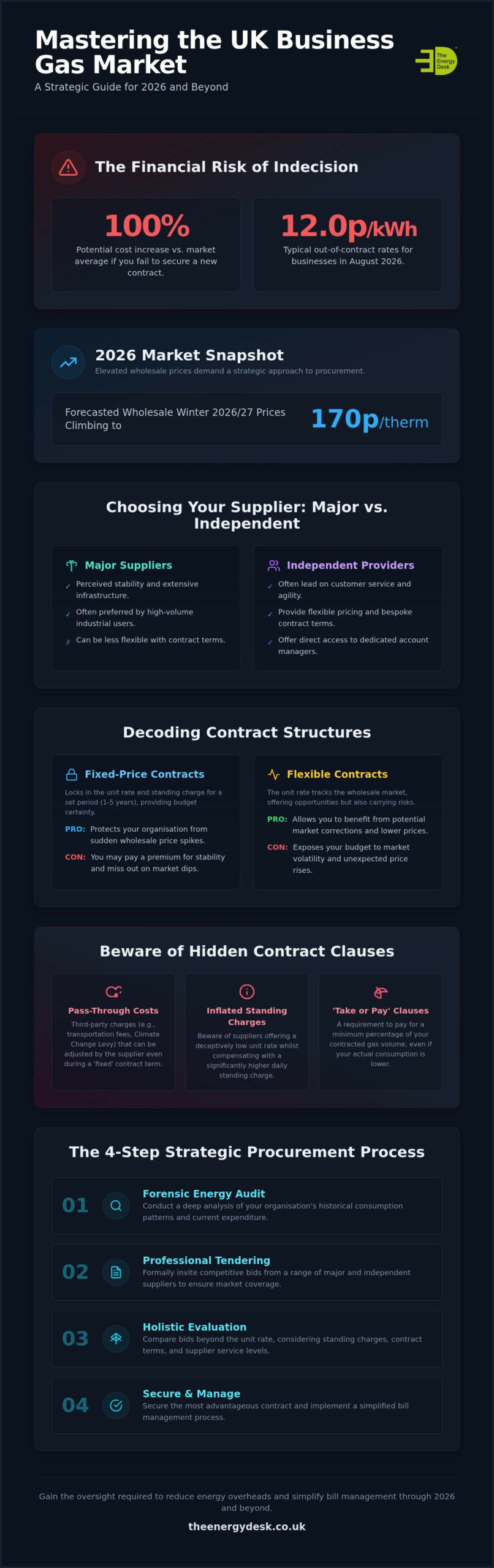
Did you know that failing to secure a new energy contract could see your organisation paying up to 100% more than the market average? With out-of-contract rates reaching 12.0p per kWh in August 2026, the financial cost of indecision has never been higher for UK enterprises. Managing utility overheads often feels like a losing battle against market volatility and opaque billing structures. You’re likely frustrated by hidden standing charges and the difficulty of comparing business gas suppliers UK on a like-for-like basis, especially when wholesale prices for the 2026/2027 winter period have already climbed to 170p per therm.
This guide provides the strategic framework you need to master the complexities of the UK commercial gas market and secure the most advantageous contracts for your organisation. We’ll analyse current wholesale trends, break down the differences between fixed and flexible procurement, and show you how to achieve long-term budget certainty. By following this methodical approach, you’ll gain the oversight required to reduce energy overheads and simplify your bill management through 2026 and beyond.
Key Takeaways
- Gain a strategic understanding of the 2026 market landscape, allowing you to effectively compare the Big Six against independent business gas suppliers UK for optimal service.
- Evaluate the trade-offs between fixed-rate stability and flexible-market agility to select the contract structure that best supports your organisation’s fiscal objectives.
- Uncover the impact of “pass-through” costs and standing charges to ensure your business isn’t caught out by unexpected fluctuations in your final energy bill.
- Learn how to execute a professional tendering process, starting with a forensic energy audit, to invite competitive bids from multiple suppliers.
- Discover the benefits of an independent brokerage model that provides expert oversight and simplified bill management without increasing your operational overheads.
The Landscape of Business Gas Suppliers in the UK for 2026
The UK commercial gas market has evolved significantly since the history of the UK gas industry began its shift toward privatisation. Today, it operates under a distinct set of rules compared to the domestic sector. Whilst residential consumers benefit from price caps, business consumers face a volatile open market where prices are dictated by wholesale fluctuations. In September 2026, wholesale gas prices have remained elevated, with forecasts for the winter season reaching 170p per therm. This environment makes the selection of business gas suppliers UK a critical financial decision rather than a simple administrative task. Ofgem continues to oversee the market to prevent unfair practices, yet the responsibility for securing a competitive rate rests entirely with the organisation.
Major Suppliers vs. Independent Providers
The market is broadly divided between legacy providers and a growing cohort of independent niche suppliers. Large, established names offer perceived stability and extensive infrastructure, which can be reassuring for high-volume industrial users. However, independent providers often lead on customer service and flexible pricing models. These smaller suppliers are typically more agile, offering bespoke terms that larger corporations struggle to match. When you evaluate supplier stability amongst fluctuating global prices, look beyond the brand name. A supplier’s ability to manage its own wholesale risk directly impacts the reliability of your supply and the consistency of your billing. Smaller providers often provide more direct access to account managers, which is vital for complex multisite organisations.
Regulatory Changes Affecting Procurement in 2026
Several regulatory shifts have been introduced in 2026 to increase market transparency. New requirements mandate that brokers and suppliers provide clearer breakdowns of their fees and commissions. This change aims to eliminate the hidden costs that historically impacted commercial contracts. Additionally, regulations regarding contract termination and renewal notices have been tightened. Suppliers must now provide proactive communication to ensure businesses aren’t rolled onto expensive out-of-contract rates, which currently sit around 12.0p per kWh. There’s also a heightened focus on carbon reporting. Many business gas suppliers UK are now required to offer greener gas options or biomethane blends to help organisations meet mandatory sustainability targets. Staying compliant requires a supplier that prioritises accurate data and transparent reporting structures.
Understanding Commercial Gas Contract Structures
Selecting the right agreement involves more than just picking a unit rate. High-volume users must decide between fixed-rate stability and flexible-market agility. When setting up a business energy contract, you’ll find that business gas suppliers UK offer varying levels of protection against market volatility. Even “fixed” contracts often contain pass-through costs. These are third-party charges, such as transportation fees or the Climate Change Levy (CCL), which can be adjusted during the contract term by the supplier to reflect regulatory changes.
Industrial gas agreements frequently include “Take or Pay” clauses. These require your organisation to pay for a minimum percentage of the contracted volume, even if your actual consumption is lower. This is a significant risk if your production levels fluctuate or if you’re implementing energy efficiency measures. Evaluating whether a 3-year fix is viable in 2026 requires a deep look at wholesale forecasts. With prices currently at 170p per therm, locking in for 36 months might provide certainty, but it could also prevent you from benefiting from potential market corrections in 2027 or 2028. You must weigh the cost of this “insurance” against your organisation’s appetite for risk.
Fixed-Price Gas Contracts
Fixed-price agreements are the standard choice for organisations prioritising budget certainty. These contracts lock in the unit rate and standing charge for a set period, typically between one and five years. This makes financial planning straightforward and protects you from sudden spikes in the wholesale market. However, be wary of “hidden” standing charges. Some business gas suppliers UK offer a low unit rate whilst significantly inflating the daily standing charge to maintain their margins. This trade-off often means you pay a premium for price security, potentially missing out on substantial savings if wholesale markets soften during your term.
Flexible Procurement for Large Organisations
For larger enterprises with high annual consumption, flexible purchasing offers a more sophisticated alternative. Instead of locking in a price on a single day, you buy gas in “tranches” throughout the year. This allows your organisation to manage market volatility by buying more when prices are low and less when they peak. Successful execution requires expert commercial energy risk management to track market movements accurately. If your current strategy lacks this level of oversight, consulting with an independent specialist can help identify more efficient procurement routes that align with your operational needs.
Criteria for Evaluating Business Gas Suppliers
Selecting from the official list of licensed gas suppliers requires a methodical evaluation that extends far beyond the headline unit price. Whilst the price per kWh is a significant factor, your organisation’s credit score often dictates the specific tariffs available to you. Suppliers use credit risk assessments to determine whether they’ll offer you their most competitive rates or require security deposits. Additionally, billing accuracy remains a major pain point; forensic bill validation frequently reveals discrepancies in standing charges or estimated readings that can erode your margins if left unchecked.
Environmental responsibility is no longer a secondary consideration. In 2026, evaluating business gas suppliers UK involves scrutinising their green credentials and the genuine availability of carbon-neutral gas options, such as biomethane. This is essential for organisations mandated to report on their Scope 1 emissions. A supplier’s ability to provide transparent carbon data is now a core requirement for any strategic procurement exercise.
Operational Reliability and Support
Technical proficiency is vital, particularly when managing a new commercial gas connection or upgrading existing infrastructure. A supplier’s performance during these transitions serves as a litmus test for their overall service quality. For multi-site portfolios, dedicated account management is indispensable. You need a single point of contact who understands your specific operational constraints rather than a generic call centre. The quality of a supplier’s online portal is another key differentiator. High-quality platforms provide real-time data collection and reporting, allowing for more precise budget forecasting and energy efficiency monitoring.
Avoiding the Pitfalls of Out-of-Contract Rates
The financial implications of failing to secure a timely renewal are severe. If your contract expires without a successor agreement, you’ll be rolled onto “deemed” or out-of-contract rates. As of August 2026, these rates average 12.0p per kWh, which is roughly 40% to 100% higher than negotiated fixed-term prices. You must identify and exit out of contract energy rates immediately to prevent significant capital leakage. To maintain budget certainty, start your procurement process at least six months before your current contract ends. This window allows business gas suppliers UK to compete for your business, giving you the leverage to negotiate more favourable terms rather than accepting a last-minute renewal offer.
The Strategic Procurement Process: Step-by-Step
Whilst many providers promise a quick quote, a professional procurement strategy is built on forensic data analysis. Successful acquisition of energy is not a one-off transaction; it’s a methodical exercise in risk mitigation. You must approach business gas suppliers UK with a clear understanding of your load profile to ensure the offers you receive are tailored to your actual operational requirements. This process prevents the common mistake of over-ordering capacity or accepting terms that don’t align with your seasonal demand shifts.
Data Aggregation and Site Audits
The foundation of any strategic tender is high-quality data. You should gather at least 12 to 24 months of historical usage data to create an accurate consumption profile. This information allows you to identify patterns and inefficiencies through a commercial energy efficiency audit. By understanding exactly where and when your organisation consumes gas, you can determine if traditional grid supply is the most cost-effective route. For high-demand industrial sites, this data often reveals that onsite generation, such as CHP systems, provides a more stable long-term financial return compared to standard market contracts. Accurate data also ensures that the Climate Change Levy (CCL), currently £0.00801 per kWh for natural gas, is applied correctly to your forecast.
Managing the Tender and Negotiation
Once your consumption profile is established, you can invite multiple business gas suppliers UK to compete for your business. It’s essential to compare these offers on a strict like-for-like basis. This means scrutinising the standing charges and pass-through elements, not just the headline unit rate. Market timing is critical during this phase. Wholesale prices for winter 2026 have already reached 170p per therm, so leveraging brief market dips to sign contracts can save your organisation thousands of pounds. Many enterprises find that using energy procurement consultants provides the necessary leverage to drive competition amongst suppliers and secure terms that aren’t available through direct web portals.
Finalising the switch requires careful coordination to manage the transition without supply interruption. You must ensure all termination notices are served correctly to your incumbent supplier to avoid being rolled onto expensive out-of-contract rates. A disciplined approach to the fine print during negotiation will protect your margins through 2026 and beyond. To begin optimising your procurement strategy, book your free energy audit with The Energy Desk today.
Optimising Your Gas Strategy with The Energy Desk
The Energy Desk serves as an independent bridge, navigating the diverse range of business gas suppliers UK on your behalf. Since our founding in 2003, we’ve prioritised objective oversight, ensuring that procurement decisions are based on data rather than supplier relationships. Our commission-based model provides a cost-neutral route to expert procurement, though we also offer fee-based management for larger corporate structures. This flexibility allows your internal teams to focus on core operations whilst we handle the technical complexities of business energy portfolio management. We act as a strategic ally, providing the stability and permanence required for long-term utility oversight.
Forensic Bill Validation and Cost Recovery
Accuracy doesn’t end when the contract is signed. Suppliers often make errors in volumetric calculations or the application of business energy standing charges. Our forensic bill validation service scrutinises every line item to identify historical overcharges and administrative discrepancies. We don’t just find these errors; we proactively manage the recovery process to return capital to your business. Technical audits of your meter setup can also reveal opportunities to downsize capacity or rectify incorrect meter classifications, further reducing fixed costs that many organisations simply accept as inevitable. This ongoing oversight ensures your chosen supplier remains accountable throughout the entire contract lifecycle.
Future-Proofing with CHP and Renewable Solutions
Long-term fiscal responsibility requires looking beyond traditional grid supply. As specialists in Combined Heat and Power (CHP), we help organisations transition to onsite generation systems that maximise thermal efficiency. This approach provides significant protection against the 170p per therm wholesale prices currently impacting the market. We also provide guidance on hydrogen-ready infrastructure and the procurement of green gas certificates to satisfy increasingly stringent environmental mandates. By diversifying your energy mix and optimising your infrastructure, you reduce reliance on business gas suppliers UK and gain greater control over your operational overheads. Contact The Energy Desk on 03330 151 221 for a free energy audit and a comprehensive review of your procurement strategy.
Securing Your Organisation’s Energy Future
Managing commercial energy in 2026 requires a shift from passive switching to active risk management. Successful procurement depends on a granular understanding of your consumption data and the ability to compare business gas suppliers UK on a strictly like-for-like basis. Whether you opt for the stability of a fixed-term fix or the agility of flexible tranches, your strategy must account for both wholesale volatility and the technical accuracy of your billing.
The Energy Desk has provided independent energy advice since 2003, helping organisations navigate these market complexities with precision. Our expert forensic bill validation services ensure you only pay for the energy you consume, whilst our specialists in industrial CHP and solar solutions offer a roadmap for reducing grid dependency. Taking control of your utility overheads is a methodical process that begins with a clear assessment of your current infrastructure.
Request your free 2026 energy audit from The Energy Desk to identify immediate cost-saving opportunities and future-proof your procurement strategy. We’re ready to help you secure a more resilient and cost-effective energy future.
Frequently Asked Questions
How do I compare business gas suppliers effectively in 2026?
Comparing business gas suppliers UK requires looking beyond the headline unit rate. You must evaluate the daily standing charge and any pass-through elements that could fluctuate during the term. It’s also vital to check the “Take or Pay” thresholds in the fine print. A professional comparison involves aggregating your historical usage data to ensure the supplier’s tariff aligns with your actual consumption profile and seasonal demand shifts.
Can I switch my business gas supplier if I am currently in a contract?
You cannot usually switch before your current contract’s end date without incurring significant exit fees. However, you can secure a new agreement with a different provider up to 12 months before your current term expires. This allows you to lock in market rates when they are favourable. Ensure you serve a formal termination notice to your incumbent supplier within the specified window to prevent an automatic rollover.
What are out-of-contract gas rates and how can I avoid them?
Out-of-contract rates are the “deemed” prices applied when your fixed-term agreement ends without a new contract in place. These rates are often 40% to 100% higher than negotiated prices, with gas rates reaching 12.0p per kWh in August 2026. To avoid these costs, maintain a methodical renewal calendar. Start tendering for new contracts at least six months before your current expiry date to ensure a seamless transition.
How long does it take to switch commercial gas providers in the UK?
The physical switch typically takes between 15 and 30 days once your existing contract has officially concluded. This timeframe assumes that your current supplier has no grounds for objection, such as outstanding debt or an unserved termination notice. Whilst the administrative transfer is relatively swift, the strategic preparation, including audits and tendering, should begin much earlier to ensure you aren’t forced into a last-minute, sub-optimal agreement.
Do business gas suppliers require a credit check?
Yes, almost all business gas suppliers UK perform credit checks during the application process. Your organisation’s credit score directly influences the tariff options available and the payment terms offered. If your credit rating is below a certain threshold, suppliers may require a security deposit or a personal guarantee before they agree to supply your site. Maintaining a strong credit profile is essential for accessing the most competitive industrial rates.
What is the difference between a gas broker and an energy consultant?
A gas broker primarily facilitates the transaction between the supplier and the business, often earning a commission on the unit rate. An energy consultant, such as The Energy Desk, provides a broader suite of strategic services. This includes forensic bill validation, infrastructure project management for CHP systems, and long-term portfolio oversight. Consultants act as a strategic ally, focusing on overall cost reduction and operational efficiency rather than just the transaction.
Are there green gas suppliers available for large industrial sites?
Yes, several specialist providers offer green gas tariffs suitable for high-volume industrial users. These often utilise Renewable Gas Guarantee of Origin (RGGO) certificates or biomethane blends. For large sites, transitioning to green gas is a vital component of meeting Scope 1 carbon reporting mandates. We help organisations evaluate these options alongside onsite generation solutions like CHP to find the most cost-effective route toward net-zero compliance without compromising reliability.
How can forensic bill validation help my business save money?
Forensic bill validation involves a line-by-line audit of your historical energy invoices to identify administrative errors or incorrect charges. Suppliers frequently make mistakes regarding VAT rates, Climate Change Levy (CCL) exemptions, or estimated readings. By uncovering these discrepancies, we can recover overpaid funds and ensure your future billing remains accurate. This service is particularly effective for multi-site portfolios where manual oversight of complex utility data is often impractical and prone to error.