
Did you know that whilst wholesale energy prices have stabilised, certain network charges on your commercial bill have surged by over 60% in 2026? It is a common frustration for directors to see costs escalate even when operations remain consistent. You are likely asking, “why are my business electricity bills so high?” whilst feeling powerless against complex invoices and unpredictable supplier price hikes. We understand that managing a corporate budget requires precision and clarity, not confusing jargon.
In this breakdown, you will discover the specific grid charges, contractual traps, and billing errors currently driving up commercial energy costs. We provide a professional analysis of the 2026 landscape, including the impact of the RIIO-ED2 price control and rising Climate Change Levy rates. By the end of this article, you will have a clear understanding of every line item on your bill. You will gain actionable steps to reduce non-consumption costs and the confidence to refine your energy procurement strategy for long term fiscal stability.
Key Takeaways
- Understand why wholesale energy prices are no longer the primary driver of your invoice and how non-commodity charges now dominate the 2026 pricing structure.
- Identify the specific network levies, including TNUoS and DUoS, that act as silent budget killers by funding national and local grid infrastructure.
- Examine the contractual traps and punitive out-of-contract rates that often explain why are my business electricity bills so high after a fixed term expires.
- Recognise the prevalence of billing errors and learn how forensic bill validation can recover overcharges and protect your operational cash flow.
- Discover how onsite generation through Solar or CHP systems provides a strategic shield against rising grid charges and reliance on external suppliers.
Understanding the 2026 Business Electricity Bill
In 2026, the disconnect between global energy market headlines and your company’s monthly statement is wider than ever. Whilst wholesale gas and power prices have stabilised from their record peaks, many directors still ask, “why are my business electricity bills so high?” despite reducing their operational output. The answer lies in a fundamental shift in how commercial energy is priced. We’ve entered the “New Normal,” where the cost of the raw energy itself is no longer the primary driver of your total expenditure.
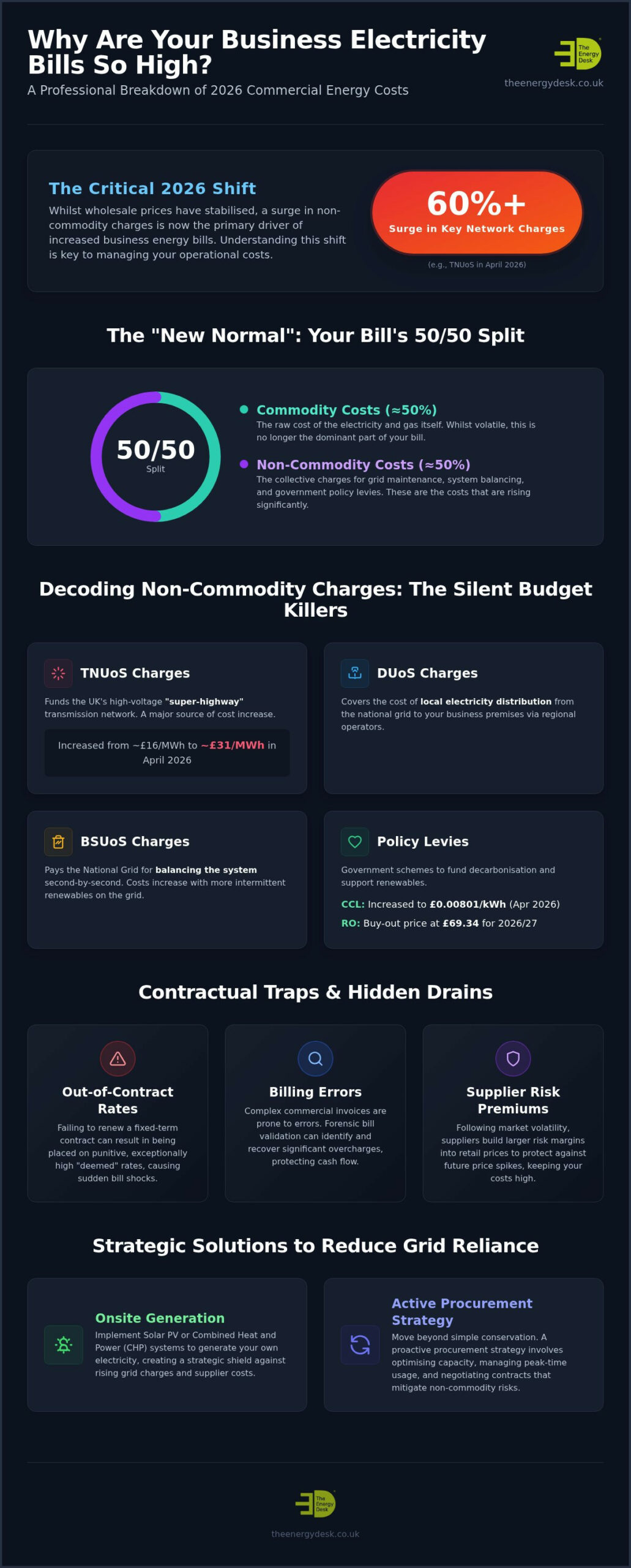
Today, your invoice is typically divided into a “50/50 split” between commodity and non-commodity costs. Non-commodity costs are the collective charges for grid maintenance, policy levies, and system balancing. In 2026, these regulated costs have risen significantly to fund the UK’s transition to a low-carbon economy. This year is particularly pivotal because it falls within the RIIO-ED2 price control period, a framework that allows network operators to collect higher revenues to upgrade ageing infrastructure. For example, Transmission Network Use of System (TNUoS) charges rose by over 60% in April 2026 alone. Understanding these electricity pricing components is essential for any organisation looking to stabilise its overheads.
The Wholesale vs. Retail Price Gap
Your business electricity rates don’t drop the moment market prices fall. This delay is largely due to “hedging,” a strategy where suppliers buy energy months or even years in advance to protect against volatility. If your supplier secured power during the high-price periods of 2024 or 2025, those costs are still being recovered through your current contract. Additionally, the extreme market volatility witnessed in recent years has led suppliers to build larger risk premiums into their retail pricing, ensuring they aren’t caught short by sudden price spikes in the future.
The Shift Toward Fixed Grid Costs
A common misconception is that energy efficiency always leads to proportional financial savings. We’re seeing a move toward capacity-based charges that remain static regardless of your actual consumption. Standing charges and network levies now represent a much larger portion of the total spend than they did five years ago. Key factors include:
- Static Standing Charges: Daily fees that apply even if the premises are closed or production is paused.
- Capacity Limits: Charges based on the maximum power your site is authorised to draw from the grid.
- Network Levies: Fees that fund the maintenance of the physical wires, transformers, and distribution hubs.
This means that even if you reduce your kWh usage by 10%, your bill might only decrease by 4% or 5%. These fixed costs ensure the network remains funded as businesses transition toward renewable alternatives and onsite generation. Managing these elements requires a strategic approach to procurement rather than simple conservation measures.
Decoding Non-Commodity Charges: The Silent Budget Killers
Whilst wholesale energy prices often capture the headlines, it’s the non-commodity elements that now dictate the true cost of your power. These charges, which cover the physical delivery of electricity and government policy objectives, now account for more than 60% of a typical commercial bill. If you’ve been questioning why are my business electricity bills so high despite stable wholesale markets, these “silent budget killers” are the likely culprit. Managing these overheads requires Understanding Changes in Electricity Bill Prices over time, as the structure of the UK grid evolves.
Your invoice includes several key regulated charges that fund the national infrastructure:
- TNUoS (Transmission Network Use of System): This funds the national “super-highway” of pylons and high-voltage cables. In April 2026, these charges rose from approximately £16 per MWh to £31 per MWh, representing a significant 60% increase.
- DUoS (Distribution Use of System): These fees cover the local delivery of power from the national grid to your specific premises via regional network operators.
- BSUoS (Balancing Services Use of System): This pays for the National Grid to maintain a constant frequency. As more intermittent renewables like wind and solar join the mix, the cost of balancing the system has climbed.
- Policy Levies: These include the Climate Change Levy (CCL), which increased to £0.00801 per kWh in April 2026, and the Renewables Obligation (RO), with a buy-out price of £69.34 for the 2026/27 period.
The Impact of Grid Electrification
The days of “Triads,” where businesses could save thousands by turning off equipment during three peak winter half-hours, have largely ended. They’ve been replaced by the Targeted Charging Review (TCR), which moved many costs from “usage-based” to “fixed bands” based on your site’s capacity. It’s now vital to check your Agreed Capacity (kVA). If your kVA is set too high, you’re paying for grid space you don’t use; if it’s too low, you’ll face punitive excess capacity penalties. A professional bill validation service can often identify where these specific charges have been misapplied or where your capacity settings require optimisation.
Contractual Traps: Out-of-Contract and Deemed Rates
Beyond the escalating grid charges discussed in previous sections, your current contract status is often the most direct reason why are my business electricity bills so high. When a fixed-term agreement expires without a replacement, you’re automatically transitioned to default pricing. This “cost of doing nothing” is a common pitfall for busy directors who miss the narrow renewal windows provided by suppliers. These default rates are not designed to be competitive; they are designed to protect the supplier’s margin against market volatility whilst you remain uncontracted.
It’s essential to distinguish between deemed rates and out-of-contract rates. Deemed rates typically apply when you move into a new premises without a formal agreement in place. Out-of-contract rates apply when your existing deal ends and you haven’t switched or renewed. In 2026, these rates act as a 2x or 3x price multiplier. For instance, whilst indicative fixed rates sit between 20p and 23p per kWh, out-of-contract rates have climbed to approximately 40.0p per kWh, accompanied by daily standing charges as high as 254.0p. If you suspect your organisation is being overcharged, follow our guide on identifying and exiting out of contract energy rates to stop the financial drain immediately.
The Danger of Rollover Contracts
Auto-renewals, or rollover contracts, can lock your business into uncompetitive rates for another 12 months without your explicit consent. Whilst micro-businesses (those consuming under 20,000 kWh annually) have specific legal protections regarding how long they can be rolled over, larger commercial entities often face more rigid terms. If you find yourself on a high-cost rollover deal, your first step should be to check the termination notice period. Missing this date by even 24 hours can prevent you from switching to a better rate for an entire year.
Strategic Procurement Timing
Signing a contract at the wrong time of year can inflate your overheads for the duration of the agreement. Market liquidity and seasonal demand often cause price spikes during the winter months. Many organisations now utilise energy procurement consultants to monitor market lows and secure “future-dated” contracts before their current deal expires. This proactive approach allows you to choose between fixed-rate security or flexible procurement, which can be more effective in navigating 2026 volatility. Additionally, engaging with energy efficiency program sponsors can provide the technical insights needed to lower your overall demand, making your business more attractive to suppliers during the tendering process.
Billing Errors and the Invisible Drain on Finances
Even if you’ve secured a competitive unit rate, administrative inaccuracies can quietly inflate your expenditure. Industry estimates suggest that up to 1 in 5 commercial energy invoices contain errors. If you’re still wondering why are my business electricity bills so high, the answer might not be the price of power, but the accuracy of the data used to calculate it. These errors often stem from technical oversights such as incorrect meter constants or multiplier mistakes, where the supplier inadvertently multiplies your actual usage by a factor of 10 or even 100.
Estimated billing remains one of the most significant risks to operational cash flow. Underpaying due to low estimates leads to “reconciliation shock” when a supplier finally receives an accurate read and demands a lump sum. Conversely, overpaying through high estimates traps capital that could be better utilised elsewhere. Implementing commercial utility bill validation allows for a forensic audit of historical data, ensuring every penny accounted for matches the energy actually consumed.
VAT and Climate Change Levy (CCL) Errors
Many organisations inadvertently pay the standard 20% VAT rate when they are legally entitled to the reduced 5% rate. This often applies to charities, non-profit organisations, or businesses with low consumption levels (typically under 1,000 kWh per month). Similarly, the Climate Change Levy (CCL) is frequently misapplied to exempt industrial processes. It’s possible to claim back up to six years of overpaid VAT and CCL, providing a significant cash injection for businesses that have been incorrectly categorised.
The Importance of Half-Hourly (HH) Data
Manual meter reads are an unnecessary risk for any modern commercial entity. Relying on human intervention increases the likelihood of data entry errors and estimation. Professional MOP contracts ensure that your meter data is transmitted digitally and accurately to your supplier every half hour. This granular visibility allows you to spot “phantom” energy usage, such as machinery or lighting left running during out-of-office hours. By using data aggregation, you can refine your consumption patterns and eliminate waste. If you suspect your invoices are inaccurate, our team offers a free energy audit to identify and recover overcharges.
Long-Term Solutions: Reducing Reliance on the Grid
While procurement strategies and bill validation address the immediate symptoms of rising costs, they don’t change the underlying dependency on an increasingly expensive national grid. Buying better is no longer enough. You must generate better. Many directors asking why are my business electricity bills so high find that the most effective answer is to bypass the grid where possible. Transitioning from a passive consumer to an active energy manager is the hallmark of a resilient 2026 organisation. There is now a compelling business case for commercial renewable energy that focuses on price certainty and operational autonomy rather than just environmental targets.
Onsite generation acts as a strategic shield against the non-commodity charges discussed in previous sections. By producing your own power, you avoid the transmission and distribution levies that now make up the majority of a standard invoice. This shift allows you to fix a portion of your energy costs for the next two decades, providing the budget stability that traditional supplier contracts can no longer guarantee in a volatile market.
Combined Heat and Power (CHP) and Solar PV
CHP systems are particularly effective for energy-intensive sectors, as they generate electricity onsite whilst capturing waste heat for industrial processes or space heating. This dual-purpose efficiency slashes total expenditure. For other sectors, Solar PV has reached a tipping point in 2026. Battery storage is now a must-have component of these installations. By storing solar energy and deploying it during peak periods, you can significantly lower your TNUoS exposure and avoid the most punitive daily standing charges. This proactive approach reduces your carbon footprint whilst simultaneously protecting your bottom line from future grid-related price hikes.
The Free Energy Audit: Your Starting Point
A professional energy audit uncovers technical inefficiencies that a standard bill check will always miss. It identifies “low-hanging fruit” such as voltage optimisation, which ensures your equipment only draws the power it needs, and LED retrofitting to reduce base-load demand. These infrastructure improvements often provide the quickest return on investment. We recommend starting with a comprehensive review of your site’s physical performance to ensure you aren’t wasting the energy you’ve already paid for. To begin your transition toward energy independence, contact The Energy Desk for a free, no-obligation energy audit and a tailored cost-reduction roadmap.
Take Control of Your Commercial Energy Strategy
Navigating the 2026 energy landscape requires moving beyond a simple comparison of unit rates. As we’ve explored, the answer to why are my business electricity bills so high often lies in the complex web of non-commodity charges, contractual default rates, and subtle billing inaccuracies. Recognising that over 60% of your invoice is now driven by grid-related levies is the first step toward reclaiming oversight of your operational expenditure. Implementing onsite generation and forensic validation are no longer optional; they’re essential for fiscal stability.
The Energy Desk has operated as an independent consultancy since 2003, specialising in everything from strategic procurement to the installation of CHP and solar solutions. We are experts in recovering five and six-figure energy overcharges for our clients. You don’t have to remain a passive recipient of rising grid costs. By auditing your infrastructure and validating every line item, you can transform energy into a managed asset. Request your free 2026 business energy audit from The Energy Desk today to secure a more resilient and cost-effective future for your organisation.
Frequently Asked Questions
Why is my business electricity bill much higher than my residential one?
Business electricity bills are higher because they lack the price cap protections afforded to domestic consumers. Commercial users are also subject to the standard 20% VAT rate, compared to the 5% reduced rate for households. Business invoices include a larger array of non-commodity charges and environmental levies, such as the Climate Change Levy, which fund national infrastructure. These additional layers of taxation and network fees significantly inflate the total cost per unit compared to domestic rates.
What are the main non-commodity charges on a UK business energy bill?
Non-commodity charges consist of the regulated costs required to maintain and balance the UK electrical grid. The primary components are TNUoS for the national transmission network and DUoS for regional distribution. You will also see BSUoS, which covers system balancing, and various policy levies like the Renewables Obligation. These fees now constitute over 60% of most commercial invoices, making them a primary driver of rising expenditure for UK organisations across every sector.
How can I tell if my business energy bill is based on an estimate?
You can identify an estimated bill by looking for the letter ‘E’ or the word ‘Estimated’ next to the meter readings on your invoice. If your supplier does not receive an actual reading from a smart meter or a manual submission, they will guess your consumption based on historical patterns. This often leads to significant inaccuracies, resulting in either lost cash flow through overpayment or a sudden reconciliation debt when an actual reading is eventually taken.
Can I claim a refund for energy overcharges from previous years?
Businesses can typically claim refunds for overcharges dating back up to six years. This process involves forensic bill validation to identify historical errors in VAT application, Climate Change Levy exemptions, or technical meter constant mistakes. These inaccuracies are remarkably common, with approximately one in five bills estimated to be incorrect. Specialist consultancies like The Energy Desk often recover substantial five and six-figure sums for companies that have been consistently overcharged by their utility suppliers.
What is the Climate Change Levy (CCL) and can my business be exempt?
The Climate Change Levy (CCL) is a government tax on commercial energy use designed to encourage efficiency and reduce carbon emissions. Whilst most businesses pay this, exemptions or reduced rates are available for registered charities, non-profit organisations, and businesses involved in specific energy-intensive industrial processes. If your organisation qualifies for an exemption but is still being charged, you can submit a PP11 form to your supplier to claim a refund and stop future charges immediately.
Is it better to have a fixed or flexible electricity contract in 2026?
The choice between fixed and flexible contracts depends on your organisation’s size and risk tolerance. Fixed contracts provide absolute budget certainty for a set period, protecting you from 2026 market volatility. Flexible procurement allows larger users to purchase energy in smaller tranches, potentially capitalising on market lows. If you are asking why are my business electricity bills so high, it’s often worth consulting an expert to determine which procurement structure aligns best with your operational requirements.
How does a half-hourly meter help reduce my electricity costs?
Half-hourly (HH) meters transmit your usage data to your supplier every thirty minutes, ensuring your invoices are always based on actual consumption rather than guesses. This granular visibility helps you identify “phantom” usage, such as equipment left running overnight. By understanding exactly when your peak demand occurs, you can implement load-shifting strategies or onsite generation to lower costs. This technology is a vital tool for organisations trying to understand why are my business electricity bills so high.
What should I do if I am placed on out-of-contract energy rates?
If you are on out-of-contract rates, you must act quickly to secure a new agreement. These default rates are significantly higher than negotiated contracts, often double or triple the market average, and include punitive daily standing charges. There is no notice period for leaving these rates, so you can switch as soon as a new contract is signed. Engaging a consultancy to tender your requirement across multiple suppliers is the most efficient way to return to competitive pricing levels.