

If your retail margins are being eroded by volatile markets, the traditional approach of simple price-comparison is no longer enough to keep your estate profitable. Effective energy procurement for retail businesses in 2026 requires a shift from reactive switching to proactive portfolio management. Managing a multi-site estate often feels like a constant battle against expiring contracts and supplier billing errors that drain your operational budget. You’re likely feeling the pressure to not only stabilise costs but also to meet increasingly stringent ESG reporting requirements whilst keeping your shops running efficiently.
This guide provides the strategic framework you need to secure fixed-price certainty, automate your bill validation, and implement renewable infrastructure like solar or EV charging to drive footfall. We’ll explore how to consolidate your procurement timeline, eliminate administrative overhead, and turn your energy strategy into a competitive advantage. By the end of this article, you’ll have a clear roadmap to protect your bottom line and accelerate your transition to net zero through disciplined, methodical utility management.
Key Takeaways
- Learn how to manage the unique load profiles of lighting and refrigeration to optimise energy procurement for retail businesses.
- Compare fixed and flexible procurement models to identify the most effective strategy for protecting your margins against market volatility.
- Discover how forensic bill validation and auditing can recover historical overcharges and eliminate recurring supplier errors across your estate.
- Develop a strategic roadmap for installing EV charging and solar infrastructure to increase customer dwell time whilst meeting net zero targets.
- Understand why an independent, whole-of-market partner is essential for managing the administrative complexity of a multi-site retail portfolio.
The Unique Challenges of Energy Procurement for Retail Businesses
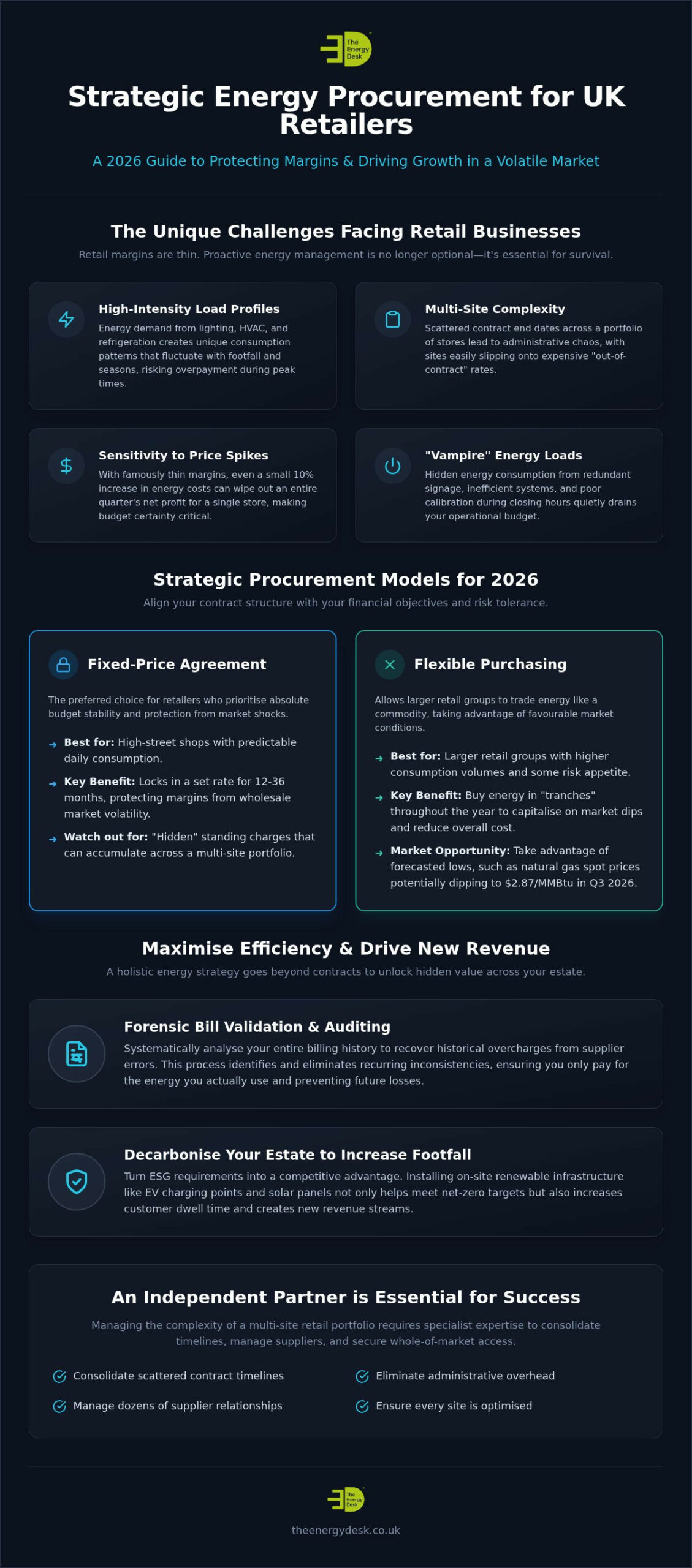
Retailers face a distinct set of operational pressures that make energy procurement for retail businesses far more complex than for standard commercial entities. Unlike a static office environment, retail demand is heavily dictated by lighting, HVAC systems, and intensive refrigeration. These factors create specific load profiles that fluctuate significantly based on footfall and external temperatures. Applying professional energy management principles is essential here, as these profiles must be analysed individually to avoid overpaying during seasonal peaks.
During high-intensity periods like the Christmas rush or major sales events, energy consumption spikes. Without a flexible procurement strategy, retailers often find themselves locked into tariffs that don’t account for these temporary surges, leading to inflated standing charges or peak-time penalties. Standard comparison sites typically fail to account for the specific kVA (kilovolt-ampere) requirements of large retail units. This often leaves businesses with contracts that don’t actually match their physical infrastructure needs, resulting in unnecessary capacity charges.
Multi-Site Complexity: The Retailer’s Burden
Managing an estate of multiple shops often turns into an administrative nightmare. Because store leases are rarely signed simultaneously, contract end dates are frequently scattered across the calendar. This fragmentation makes it easy for individual sites to slip onto “out of contract” rates, which are significantly higher than negotiated tariffs. Managing dozens of different supplier relationships also increases the risk of billing inconsistencies and missed validation opportunities. Implementing a cohesive business energy portfolio management strategy allows retailers to consolidate these timelines. This brings order to the chaos and ensures no single site is left exposed to market volatility.
The Impact of Volatile Margins on Energy Strategy
Retail margins are notoriously thin. A sudden 10% increase in energy costs can potentially wipe out a store’s entire net profit for the quarter. This makes budget certainty a critical pillar of financial planning for 2026. Beyond the unit price, retailers must also address “vampire” energy loads. These are the systems that continue to consume power during closing hours, such as redundant signage lighting or poorly calibrated climate controls. Identifying and eliminating these hidden costs is weightless for protecting the bottom line. A strategic approach to energy procurement for retail businesses ensures that every kilowatt-hour is accounted for and every contract is optimised for the specific operational reality of the high street, a focus that is often shared by retail design experts like hildebrands GmbH who specialise in creating efficient commercial spaces.
Selecting a contract structure is a pivotal decision in energy procurement for retail businesses. The choice between fixed-price certainty and flexible market participation often depends on the scale of your estate and your tolerance for risk. Utilising professional RFP management and negotiation assistance can help clarify these options and ensure you secure the most competitive terms for your portfolio. By aligning your procurement model with your financial objectives, you can effectively hedge against the price spikes seen in the 2026 energy cycle. Each model offers distinct advantages for managing the high-intensity demand of retail environments.
When to Choose a Fixed-Price Agreement
Fixed-price contracts remain the preferred choice for high-street retailers who prioritise budget stability. These agreements lock in a set rate for a specific duration, typically 12 to 36 months, protecting your margins from sudden wholesale market fluctuations. However, it’s vital to scrutinise the fine print to avoid “hidden” standing charges that can accumulate across a multi-site portfolio. Integrating these fixed deals with a broader strategy for business electricity procurement ensures that every meter is accounted for under a single, transparent management framework. This setup is particularly effective for shops with predictable daily consumption patterns.
Flexible Purchasing for Mid-Market Retailers
For larger retail groups with higher consumption volumes, flexible procurement offers a way to trade energy like a commodity. Instead of locking in a single price, you buy energy in “tranches” throughout the year. This allows you to take advantage of market dips, such as the forecasted natural gas spot price lows of $2.87/MMBtu in Q3 2026. Success in this model relies heavily on commercial energy risk management. Without professional oversight, your estate could be left over-exposed during periods of extreme volatility. Flexible models require constant monitoring but can deliver significant savings compared to a static contract.
Many smaller retail units also benefit from basket purchasing. By grouping multiple sites together, you increase your collective buying power and access rates usually reserved for industrial-scale consumers. This approach mirrors the efficiency goals seen in federal energy management programs, where utility management is centralised to drive down costs. Timing is equally critical. Entering the market during the right phase of the 2026 cycle can be the difference between a competitive deal and a cost-heavy mistake. If you’re unsure which model fits your current estate, you might consider an independent energy audit to evaluate your options and identify potential savings.
Maximising Efficiency through Forensic Bill Validation
Managing energy procurement for retail businesses extends far beyond the initial contract negotiation. For multi-site estates, the administrative complexity of managing various meter types and supply points often leads to significant billing discrepancies. Supplier errors aren’t just minor oversights; they’re frequent occurrences that can quietly erode your retail margins over several years. Forensic bill validation serves as a critical safeguard, ensuring that your actual expenditure aligns perfectly with your negotiated tariffs and that you aren’t paying for supplier incompetence.
Common issues in the retail sector include incorrect VAT applications, where sites qualifying for the 5% reduced rate are incorrectly charged at 20%. Miscalculations of the Climate Change Levy (CCL) are also prevalent, especially for retailers with mixed-use premises. Estimated billing is a particular risk during seasonal peaks; suppliers often over-project usage based on historical data rather than real-time consumption. Automated data collection eliminates these inaccuracies, providing the transparent reporting required for modern ESG compliance and financial oversight.
The ROI of Forensic Auditing
Conducting a thorough commercial utility bill validation is a zero-risk strategy for any retailer. Unlike standard bill checking, which only scrutinises current invoices, forensic auditing involves a retrospective look-back of up to six years. This process identifies historical overcharges that standard software or internal accounting teams often miss. Many multi-site retail estates have recovered five-figure sums through this process, essentially finding “lost” capital that can be reinvested into store improvements or net zero initiatives.
Managing Half-Hourly Data for Retail
Large retail units with high demand are subject to specific half hourly metering requirements UK. To manage these effectively, you must have robust Data Collection and Data Aggregation (DC/DA) services in place. This granular insight allows you to see exactly when your shops are consuming the most power. By identifying peak demand periods, you can implement load-shifting strategies, such as pre-cooling refrigeration units before peak pricing kicks in or adjusting HVAC schedules. This proactive approach turns raw data into actionable intelligence, ensuring your procurement strategy remains as lean and efficient as possible.
Decarbonising the Retail Estate: From Cost to Revenue
Decarbonisation is no longer a peripheral concern for the retail sector. With the UK government’s Net Zero targets for 2030 and 2050 approaching, energy procurement for retail businesses must evolve to include renewable infrastructure. Shifting to a low-carbon model isn’t just about compliance; it’s a strategic move to insulate your estate from rising carbon taxes and volatile wholesale prices. Many retailers are now prioritising REGO-backed (Renewable Energy Guarantees of Origin) contracts to align their energy sourcing with their brand values, providing a transparent way to demonstrate environmental commitment to a conscious consumer base.
The Business Case for Retail EV Infrastructure
Retailers with physical car parks sit on a significant asset for revenue generation. Installing destination EV charging points attracts high-value drivers who are likely to spend more time in-store whilst their vehicles charge. This increased dwell time directly correlates with higher average transaction values. Modern energy procurement for retail businesses often includes revenue-sharing models for charging stations, where the hardware is installed with minimal upfront capital in exchange for a portion of the charging fees. It’s a vital component of a broader business case for commercial renewable energy UK, turning a required utility into a profitable service.
Onsite Generation: Solar and CHP
For larger retail centres or supermarkets with constant thermal and electrical needs, CHP system installation for businesses provides a highly efficient solution. By generating power onsite, you bypass a significant portion of “Pass-Through” charges, specifically Distribution Use of System (DUoS) and Transmission Network Use of System (TNUoS) costs. These non-commodity charges can account for up to 60% of a retail energy bill. Solar PV installations on expansive retail rooftops offer similar benefits, significantly reducing grid reliance during daylight hours. In 2026, various grants and funding schemes are available to offset the initial installation costs of these projects, provided the procurement strategy is managed methodically. Securing these incentives requires a disciplined approach to infrastructure planning and utility oversight.
If you’re ready to transition your estate from a cost centre to a revenue-generating asset, you can book a free energy audit with our specialist team to explore your renewable options.
Choosing the Right Procurement Partner for Your Retail Business
Generic comparison sites are designed for micro-SMEs with single meters. They lack the technical depth to manage complex retail kVA requirements or multi-site alignment. Effective energy procurement for retail businesses requires more than a simple price check; it demands a partner who can synchronise contract end dates across an entire estate. This methodical approach ensures you aren’t caught off guard by expiring agreements that leave your shops exposed to market volatility.
One of the most immediate benefits of expert management is the ability to identify and exit out of contract energy rates. These default tariffs are significantly higher than negotiated rates, yet they’re a common reality for retailers who lack a centralised procurement strategy. The Energy Desk acts as a strategic ally, handling the administrative heavy lifting of supplier negotiations and forensic auditing so your team can focus on store operations.
Consultants vs. Brokers: What Retailers Need to Know
Distinguishing between a broker looking for a quick commission and energy procurement consultants who focus on long-term ROI is essential for retail managers. Brokers often prioritise a “quick switch” without considering broader energy management needs. In contrast, a consultancy approach looks at your entire estate’s performance, ensuring transparency in all service fees and commissions. This level of oversight allows retailers to turn energy from a passive cost into a strategic asset that supports long-term fiscal responsibility.
Next Steps: Securing Your 2026 Energy Strategy
Preparing for a comprehensive review of energy procurement for retail businesses is a low-friction process. You only need to provide recent bill data and a signed Letter of Authority (LOA). This documentation enables us to conduct the forensic audit necessary to identify the historical overcharges we’ve discussed. We also evaluate your sites for footfall-driving infrastructure like EV chargers, ensuring your strategy is ready for the 2026 market landscape and beyond.
With over 20 years of experience since our founding in 2003, we provide the stability needed to manage utility portfolios through any economic cycle. Our team handles the complex data collection and supplier disputes on your behalf. To begin your estate review and secure your 2026 budget, contact our specialist team on 03330 151 221. We’ll help you build a resilient, net-zero-ready energy strategy that protects your margins and enhances your customer experience.
Future-Proofing Your Retail Estate Portfolio
Securing a resilient energy strategy for the coming years requires a shift from simple price-comparison to comprehensive portfolio management. By moving beyond reactive contract switching, you can implement forensic bill validation to recover lost capital and adopt procurement models that provide genuine budget certainty. Precision is essential for profitability. Transitioning your retail units into high-performance assets through solar PV or EV charging infrastructure not only meets net zero targets but also turns utility management into a driver for customer footfall.
Managing the complexities of energy procurement for retail businesses is an ongoing process that benefits from dedicated, expert oversight. As an independent whole-of-market consultancy with over 20 years of experience, we specialise in the administrative heavy lifting required to manage multi-site estates. You can request your free retail energy audit from The Energy Desk today to begin identifying immediate savings and long-term infrastructure opportunities. Taking these methodical steps now will ensure your margins remain protected whilst your business leads the transition to a sustainable retail future.
Frequently Asked Questions
How does energy procurement differ for multi-site retail businesses?
Multi-site procurement requires a centralised approach to synchronise contract end dates across different lease cycles. Unlike single-site businesses, retail estates must manage varying kVA requirements and complex meter setups simultaneously. Centralising energy procurement for retail businesses prevents sites from falling onto expensive out-of-contract rates. This methodical oversight allows for better volume-weighted negotiations with suppliers, as your total consumption across the estate provides greater leverage than individual shop agreements.
Can retail businesses secure green energy contracts at competitive rates?
Retailers can access competitive renewable energy through REGO-backed contracts that guarantee the power comes from sustainable sources. Whilst green tariffs were once significantly more expensive, the maturing market and increased supplier competition have narrowed the price gap. An independent consultancy can help you navigate the whole-of-market options to find renewable deals that align with your ESG targets without compromising your margins. These contracts are essential for branding in a conscious consumer market.
What is forensic bill validation, and how can it help my retail store?
Forensic bill validation is a retrospective audit that scrutinises your energy invoices for the past six years to identify overcharges. In the retail sector, complex billing for multiple sites often leads to errors in VAT rates, Climate Change Levy (CCL) calculations, or estimated readings. By identifying these discrepancies, you can recover significant capital that was previously lost to supplier incompetence. This process is a zero-risk strategy that directly protects your bottom line.
Is it possible to align all my retail energy contracts to a single end date?
You can align your estate’s utility agreements through coterminous contracts, which set a unified expiry date for every site. This alignment simplifies the administrative burden of managing multiple renewals throughout the year. Achieving this usually involves a strategic transition period where new contracts are negotiated to end on a specific future date. Once aligned, your procurement process becomes much more efficient, allowing you to go to market with your entire portfolio at once.
How much can a retail business save by switching energy procurement strategies?
Savings vary depending on the current state of your estate, but moving from default rates to a strategic contract can reduce costs significantly. Beyond the unit price, retailers often find additional savings of 5% to 10% through forensic bill validation and the elimination of “vampire” energy loads. Implementing energy procurement for retail businesses that includes onsite generation or load-shifting strategies can further decrease your reliance on the grid, protecting your retail margins from future wholesale price spikes.
What are the benefits of installing EV chargers at retail locations?
Installing EV chargers turns your car park into a revenue-generating asset whilst increasing customer dwell time. Drivers are more likely to spend money in your store whilst their vehicle charges, leading to higher average transaction values. Additionally, revenue-sharing models allow you to host charging infrastructure with minimal capital expenditure. This infrastructure also helps your business meet net zero targets and attracts a growing demographic of high-value, environmentally conscious consumers to your locations.
How do I avoid paying out of contract energy rates during a store move?
Avoiding expensive out-of-contract rates during a move requires early notification to your supplier and a clear Letter of Authority (LOA). You should engage a procurement partner at least three months before a lease change to ensure new meters are registered and contracts are transferred correctly. This proactive management prevents the “deemed rates” that suppliers often apply to new occupants, which can be double the cost of a standard commercial energy agreement.
Will a free energy audit disrupt my daily retail operations?
A professional energy audit is a non-intrusive process that focuses on data analysis rather than physical disruption. Most of the work is conducted off-site using your historical billing data and half-hourly meter readings provided via a Letter of Authority. If a site visit is required for infrastructure planning, such as solar or EV installation, it is scheduled during off-peak hours to ensure your staff and customers are not inconvenienced.